

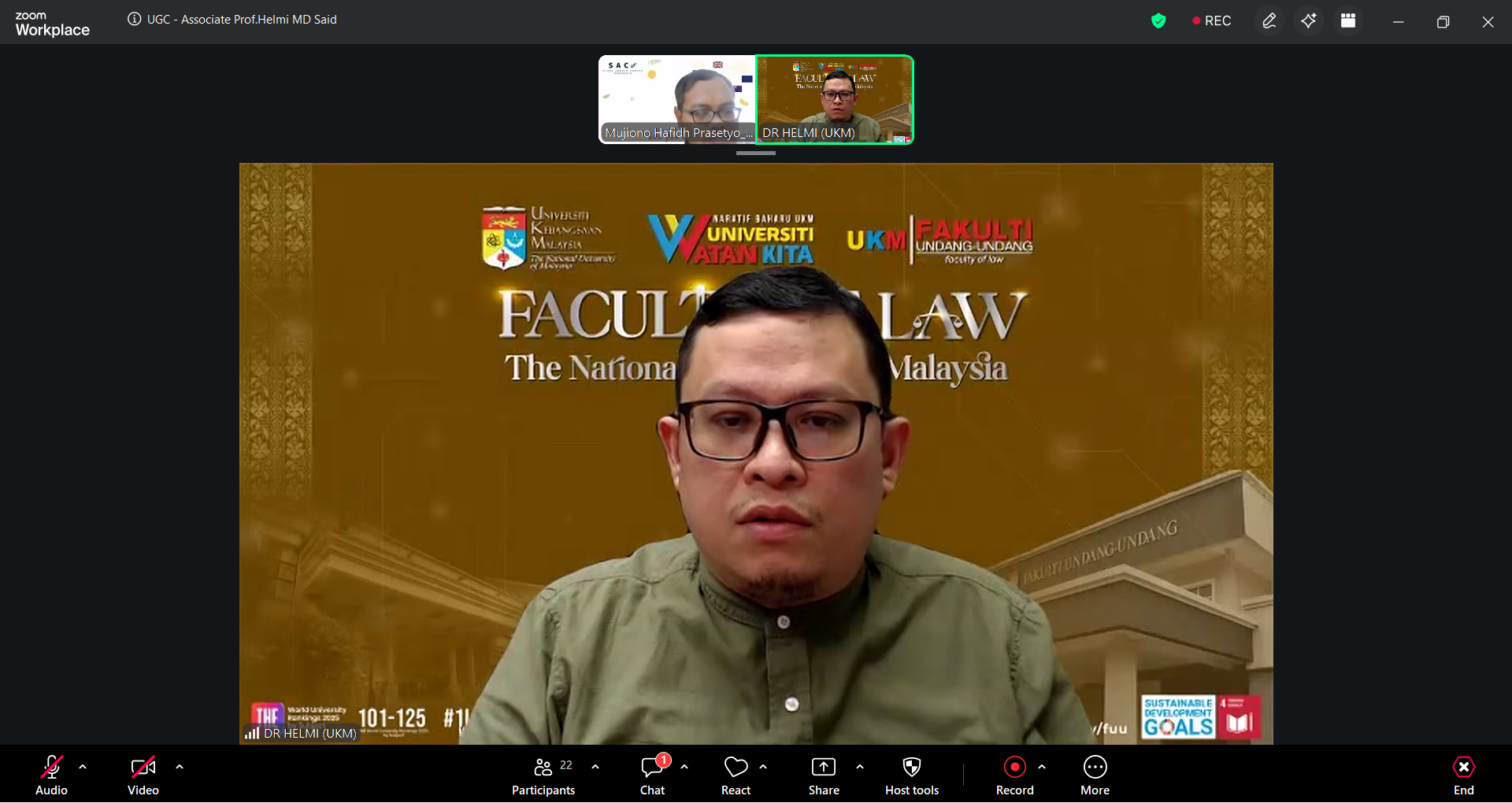
The Faculty of Law at Universitas Diponegoro once again held the Undip Global Classroom (UGC) on Wednesday, May 6, 2026, featuring Associate Prof. Helmi MD Said from The National University of Malaysia as the keynote speaker. Themed “The Enforcement of Digital Forensics in Cases Involving Corruption,” the event was aimed at Comparative Criminal Law students, with Mujiono Hafidz Prasetyo, S.H., LL.M. as the discussant. The event, held online via Zoom, aimed to broaden students’ understanding of the role of digital forensics in law enforcement investigations of corruption in the digital age.
In his presentation, Associate Prof. Helmi explained that advances in information technology have changed crime patterns, including corruption, which now often involves electronic communications, digital transactions, cloud-based data storage, and mobile devices. Therefore, the investigation and inquiry process can no longer rely solely on conventional evidence; it also requires a digital forensic approach to obtain, secure, analyze, and present electronic evidence scientifically and in a form admissible in court.
He emphasized that digital forensics is not merely the extraction of data from electronic devices, but a scientific discipline that prioritizes the integrity of digital evidence. Every data acquisition process must be carried out according to procedures to avoid altering the content or metadata of the evidence. Concepts such as chain of custody, complete documentation, and the use of validated forensic methods are key requirements for electronic evidence to have strong evidentiary value.
He further explained that in corruption cases, digital evidence can come from various sources, such as emails, instant messaging conversations, CCTV recordings, electronic documents, digital banking transactions, mobile phone data, and even social media activity. Through digital forensic techniques, investigators can reconstruct the chronology of events, identify relationships between perpetrators, trace transaction flows, and even recover deleted data to support criminal prosecution.
Associate Prof. Helmi also discussed the various challenges in implementing digital forensics. Data encryption, the use of cloud computing services, the development of artificial intelligence technology, and even transnational crime present unique challenges for law enforcement officials. Therefore, increased investigator capacity, regulatory updates, and international cooperation are needed to ensure law enforcement processes can keep pace with increasingly complex technological developments.
In addition to technical aspects, the presenters emphasized that the use of digital forensics must continue to adhere to human rights, particularly privacy protection and legal certainty. The collection and examination of electronic evidence must be conducted with lawful authority, in accordance with applicable legal procedures, and in a manner that balances law enforcement effectiveness with the protection of individual rights.
In the discussion session, Mujiono Hafidz Prasetyo, S.H., LL.M., reviewed the application of electronic evidence in the Indonesian legal system and its relevance to the investigation and prosecution of corruption crimes committed by law enforcement officials. The discussion turned to a comparison of digital forensic practices in Indonesia and Malaysia, including the challenges of regulatory harmonization, improving the competence of digital forensic experts, and strengthening law enforcement institutions’ capacity to address technology-based crimes.
Through the Undip Global Classroom, students gained a more comprehensive understanding of the importance of digital forensics as a key tool in proving corruption in the digital age. This activity also broadened students’ perspectives on developments in criminal procedure law and information technology within the context of comparative law, while strengthening the international academic network between the Faculty of Law at Universitas Diponegoro and Universiti Kebangsaan Malaysia.