

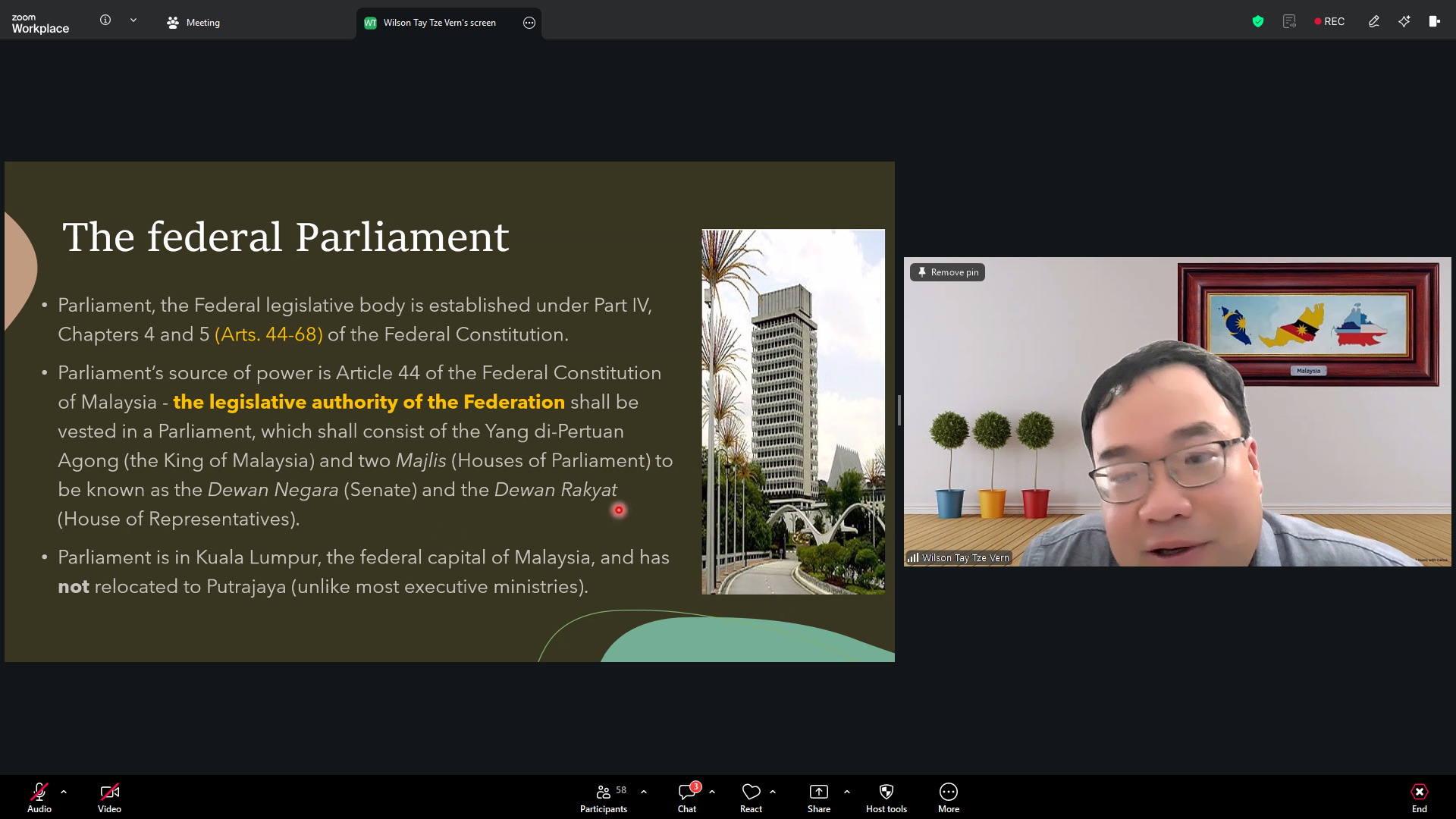
The Faculty of Law at Universitas Diponegoro once again held the Undip Global Classroom (UGC) on Tuesday, May 5, 2026, featuring Dr. Wilson Tay Tze Vern from The National University of Malaysia as the keynote speaker. Themed “Legislative Body in Malaysia,” the event was held for IUP students majoring in Constitutional Law, with Dr. Ratna Herawati, S.H., M.H. as the discussant. The event, held online via Zoom, allowed students to broaden their knowledge of the Malaysian constitutional system from a comparative constitutional law perspective.
At the beginning of his presentation, Dr. Wilson explained that the legislative body is a state organ with the authority to create, amend, and revoke laws and regulations, and to exercise oversight over the executive branch and to represent the aspirations of the people. Legislative bodies can be either unicameral or bicameral, depending on each country’s constitutional structure.
As is well known, Malaysia is a federal state comprising 13 states and 3 federal territories, with legislative bodies at both the federal and state levels. At the federal level, legislative power rests with the Parliament of Malaysia, established under the Federal Constitution and consisting of the Yang di-Pertuan Agong, the Dewan Negara (Senate), and the Dewan Rakyat (House of Representatives). This system adopts the Westminster bicameral system, while all state-level Dewan Undangan Negeri (Dewan Undang-undang Negeri) operate under a unicameral system.
Dr. Wilson emphasized that although Parliament has extensive legislative authority, this power is not absolute. Unlike the British doctrine of parliamentary sovereignty, the Malaysian Parliament is subject to the Federal Constitution, which serves as the supreme law of the land. Therefore, any law that conflicts with the Constitution or falls outside the legislative authority can be declared unconstitutional by the courts. The speaker cited the Ah Thian v. Government of Malaysia (1976) decision as a key foundation affirming constitutional supremacy in Malaysia.
In the following session, participants received an explanation of the Malaysian Parliament’s primary functions. In addition to enacting laws and amending the Constitution, Parliament also has the authority to oversee the government, approve the state budget (Supply Bill), control fiscal policy through tax approval, and oversee the use of state funds through the Public Accounts Committee (PAC). These functions demonstrate that the legislative body plays a role not only as a lawmaker but also as a check-and-balance mechanism in governance.
Dr. Wilson also outlined the relationship between Parliament and the Government in Malaysia’s parliamentary system. The government is formed from members of Parliament who command majority support in the Dewan Rakyat, so the cabinet’s survival depends on parliamentary confidence. Loss of majority support, for example, through a motion of no confidence or failure to pass the state budget, can result in the government resigning or requesting the dissolution of Parliament, as stipulated in the Constitution.
In addition to legislative and oversight functions, the speaker explained the importance of the representative function. Members of Parliament have a responsibility to convey the aspirations of the people through debates, Question Time, deliberations on draft laws, and committee work. In carrying out these functions, members of Parliament are granted parliamentary privilege, allowing them to freely express their opinions in the public interest without fear of legal action, provided they remain within the constitutional framework.
The discussion session, moderated by Dr. Ratna Herawati, S.H., M.H., was interactive, discussing various comparative aspects between the legislative systems of Malaysia and Indonesia, particularly regarding the division of authority between the central and state governments, the mechanism for forming laws, and the role of the Constitution as a limiter of legislative power. Through the implementation of this Undip Global Classroom, students gained a more comprehensive understanding of the structure and function of legislative institutions in the Malaysian federal system. This activity also strengthened students’ perspective on comparative constitutional law, an important tool for understanding the development of constitutional systems across countries.