
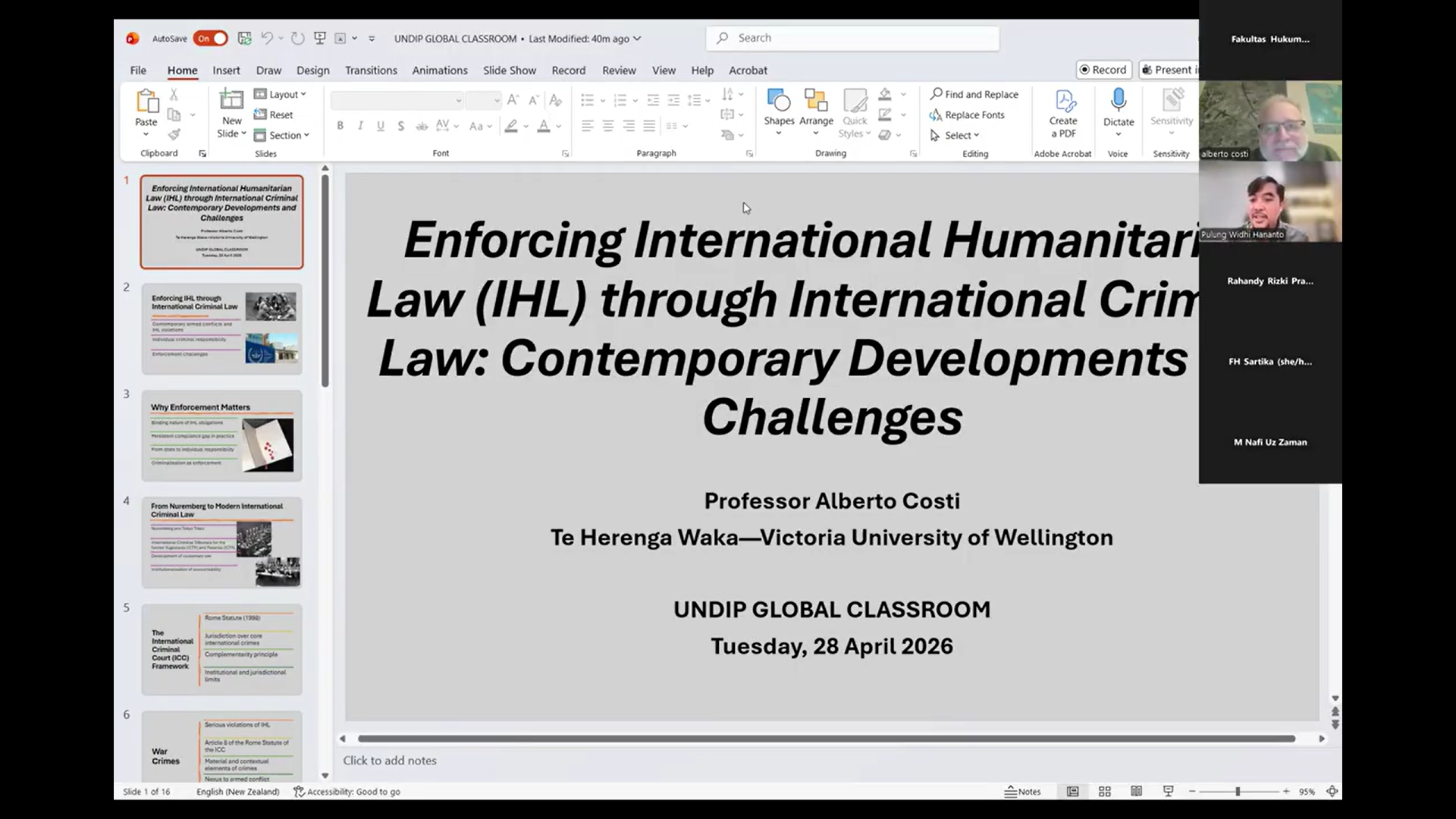
The Faculty of Law at Diponegoro University once again held the Undip Global Classroom (UGC), featuring Prof. Dr. Alberto Costi, Ph.D., from Victoria University of Wellington, as the keynote speaker. Held on Tuesday, April 28, 2026, the event raised the theme “Enforcing International Humanitarian Law through International Criminal Law: Contemporary Developments and Challenges,” with Pulung Widhi Hari Hananto, S.H., M.H., LL.M. as the discussant.
In his presentation, Prof. Costi highlighted that international humanitarian law (IHL) essentially has a relatively well-established normative framework. However, the main issue lies in the effectiveness of its enforcement, particularly through international criminal law mechanisms. In other words, the problem is not “what the law is,” but “how it is enforced.”
Furthermore, it was explained that international criminal law, through institutions such as the International Criminal Court (ICC), is designed to prosecute serious violations of IHL, including war crimes and crimes against humanity. However, the effectiveness of these mechanisms is often limited by jurisdictional principles, state sovereignty, and reliance on state cooperation in law enforcement.
The discussion then turned to contemporary dynamics, in which modern armed conflicts pose new challenges to existing legal regimes. The fragmentation of actors, the use of new military technologies, and the complexity of non-international conflicts demonstrate that existing legal frameworks often lag behind the realities of practice on the ground.
Furthermore, the tension between the principle of global accountability and the realities of international politics was discussed. In many cases, the enforcement of international criminal law is not entirely independent of political considerations, which ultimately affect the consistency and legitimacy of the law enforcement process. Through this session, participants not only gained an understanding of the relationship between IHL and international criminal law but were also encouraged to critically examine the limitations of the international legal system in addressing the challenges of contemporary conflict. This emphasized that strengthening the international law enforcement regime is not achieved solely through norm development but also requires stronger political and institutional commitment at the global level.