
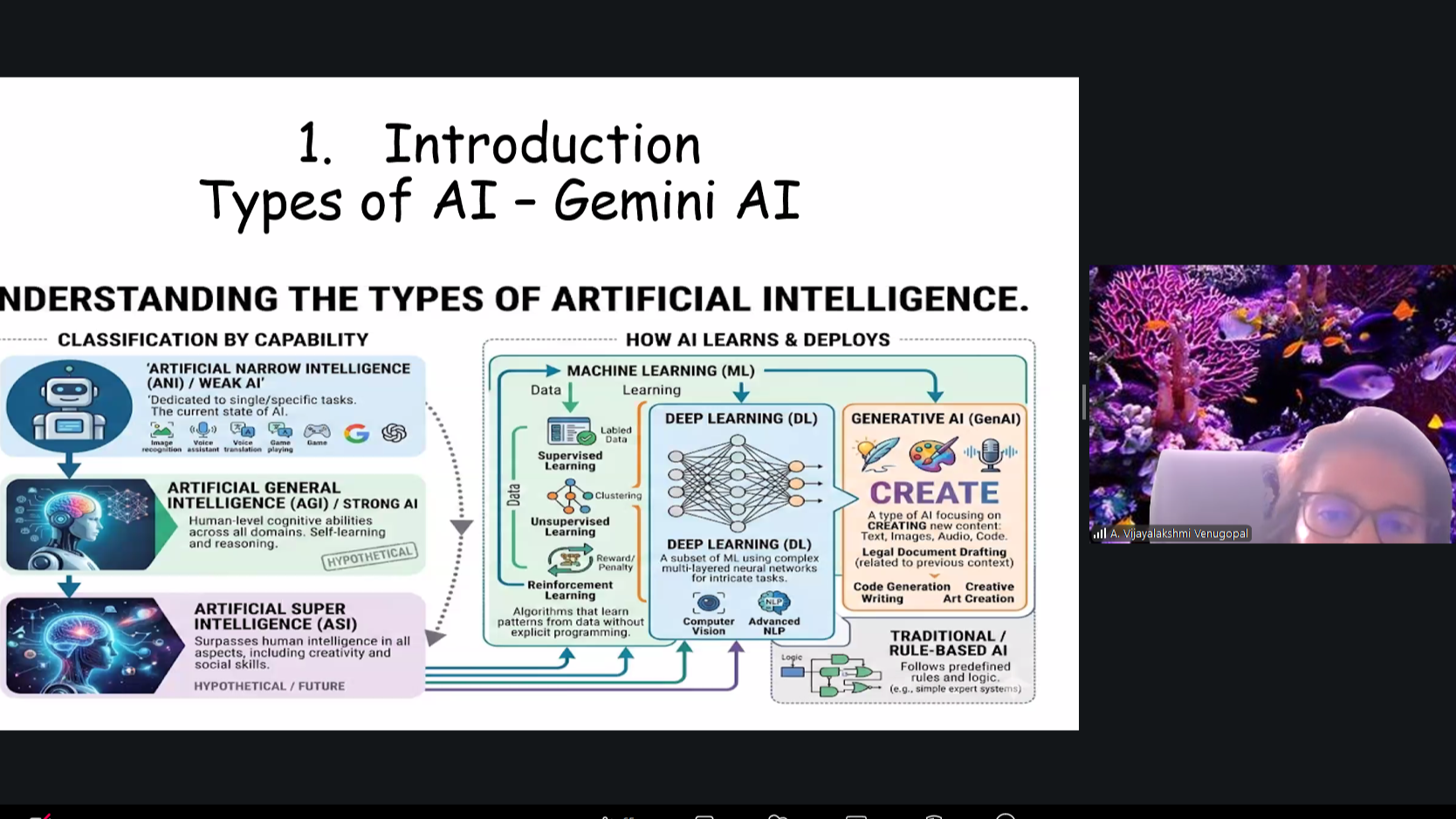
The Faculty of Law at Diponegoro University once again held the Undip Global Classroom (UGC) with a theme relevant to technological developments in legal studies. Held on Friday, April 17, 2026, the event featured Dr. A. Vijayalakshmi Venugopal, LL.B., LL.M. from Taylor’s University as the keynote speaker, with Marzellina Hardiyanti, S.H., M.H. as a discussant.
In this lecture on “Artificial Intelligence Tools in Legal Research,” we comprehensively discussed the role and implications of using artificial intelligence, particularly generative AI, in the legal research process. Dr. Vijayalakshmi, who also serves as Head of Teaching and Learning at Taylor’s University’s Faculty of Business and Law and is actively developing guidelines for the use of AI in learning, emphasized that AI technology has become an integral part of legal academic and professional practice.
In her presentation, she explained the development of Artificial Intelligence, from rule-based systems to machine learning, deep learning, and generative AI, which can generate new content such as text, images, and code. She also outlined the fundamental differences between traditional AI and generative AI: generative AI focuses on creating new content, while traditional AI focuses more on data analysis and prediction.
Dr. Vijayalakshmi then outlined the various benefits of using AI in an academic context, including helping students understand complex concepts, developing writing outlines, and providing early feedback on the quality of their writing. However, Dr. Vijayalakshmi also emphasized the serious challenges, particularly those related to academic integrity. Risks such as plagiarism, over-reliance, and the emergence of inaccurate information (hallucinations) are major concerns in the use of AI in educational settings.
In response to these challenges, she emphasized the importance of a responsible, ethical approach to AI. Students are encouraged to use AI as a tool, not as a substitute for critical thinking. The principles of transparency, information verification, and adherence to academic policies are key elements in ensuring the appropriate use of AI.
This activity was attended by students from the Research Methodology and Legal Writing classes, and the discussion was lively and reflective. Questions raised not only focused on the technical aspects of AI use, but also on the normative and ethical implications in legal research. Through this activity, the Faculty of Law at Diponegoro University reaffirmed its commitment to responding to the development of digital technology in legal education, while equipping students with adaptive, critical, and responsible skills in utilizing technological innovation. Second Series of UGC Discusses the Role of International Maritime Law in Addressing Climate Change
The Faculty of Law, Diponegoro University, once again held the second series of the UNDIP Global Classroom (UGC) 2026, highlighting current issues in international law. Themed “International Tribunal for the Law of the Sea (ITLOS) on the Law of the Sea and Climate Change,” the event highlighted the relevance of international maritime law in addressing global climate change.
The discussion began with the fundamental question of whether the current maritime law regime is adequate to address the increasingly complex dynamics of climate change. Environmental changes impacting the oceans, coastlines, and state responsibilities demand new interpretations and approaches to international law.
The keynote speaker was Prof. Volker Roeben, Ph.D., from Durham University. In his presentation, he explained that the role of international tribunals, particularly the International Tribunal for the Law of the Sea (ITLOS), is no longer limited to dispute resolution but is also evolving to interpret state legal obligations amidst rapid global change.
M. Nafi Uz Zaman, S.H., M.H., also attended as a discussant, providing additional perspectives and critical responses to the issues raised in the discussion. The interaction between the speakers and participants was dynamic, reflecting the strong interest in connecting international law with environmental issues.
The event, held online via Zoom on Tuesday, April 14, 2026, was attended by students, particularly those taking the International Law course, as well as members of the Diponegoro University Faculty of Law (Undip). The discussion provided a reflective space to explore the adequacy of the existing legal framework and to encourage new thinking regarding legal adaptation to global environmental urgencies.
Through the UNDIP Global Classroom, the Diponegoro University Faculty of Law continues to demonstrate its commitment to providing learning that is responsive to global issues and strengthens students’ academic capacity to critically and comprehensively understand developments in international law.