
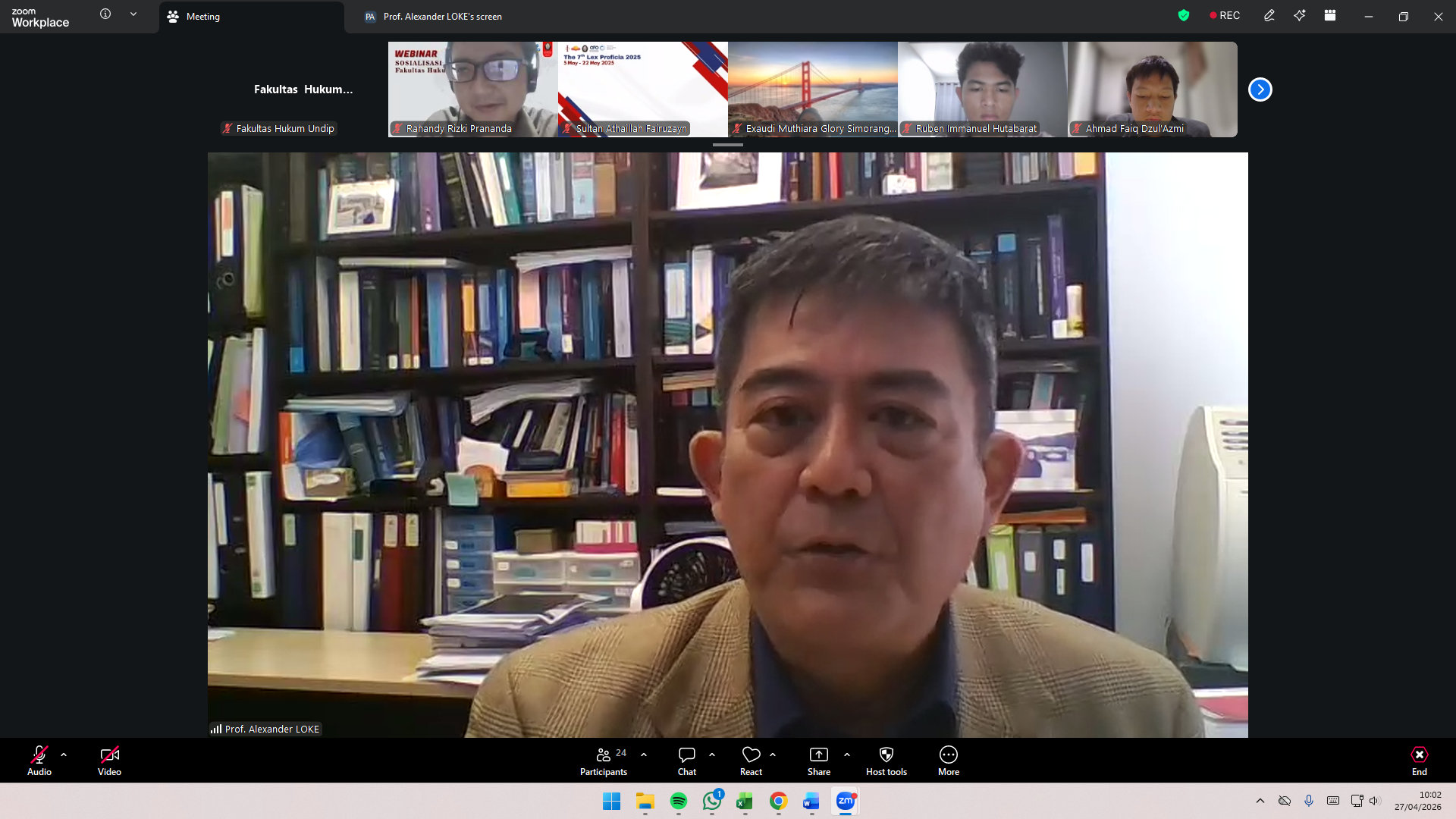
The Faculty of Law at Diponegoro University once again held the Undip Global Classroom (UGC) with Prof. Alexander Loke, LL.M., SJD., from the City University of Hong Kong, as the keynote speaker. Held on Monday, April 27, 2026, the event raised the theme “Security and Quasi-Security Interests in the Common Law: The Conception of ‘Property’ and the Creativity of Common Lawyers,” with Rahandy Rizki Prananda, S.H., M.H., as the discussant.
In his presentation, Prof. Loke emphasized that the concept of a security interest in the common law system cannot be separated from a fundamental understanding of property. In financing practice, providing collateral is a mechanism to grant priority to creditors by transferring or encumbering rights over an asset. This is evident, for example, in property financing schemes, where the creditor obtains the right to execute the asset if the debtor defaults.
Prof. Loke also outlined various forms of security interests in common law, such as pledge, mortgage, and charge, each with distinct characteristics, particularly regarding asset control, transfer of ownership, and enforcement mechanisms. The analytical structure, encompassing agreement, attachment, perfection, and priority, is key in determining whether an instrument truly creates effective property rights.
One important point raised was that not all arrangements that legally appear to be guarantees actually create security interests. In some cases, failure to fulfill the formation elements can cause a transaction to lose its security character and be viewed as merely an ordinary agreement. This demonstrates the importance of accurate legal construction as a crucial factor in financing practices.
The discussion then evolved into the concept of quasi-security interests, namely, various forms of transactions that functionally resemble guarantees but are legally structured through mechanisms such as assignment or factoring. This phenomenon reflects the creativity of legal practitioners in designing instruments that can provide economic protection for creditors without always using conventional forms of guarantee.
Furthermore, the concept of a floating charge was introduced, which allows debtors to continue using assets in their daily business activities until certain conditions occur that cause the collateral to “crystallize.” This mechanism demonstrates the flexibility of common law in accommodating the needs of the business world, while also emphasizing that the dynamics of economic practices strongly influence the development of collateral law.
Through this session, participants gained an understanding that collateral law in the common law tradition is not simply a static set of doctrines, but rather the result of evolution supported by judicial interpretation and by legal practitioners’ innovation. Therefore, mastering the basic concepts of property interest is a crucial prerequisite for understanding and developing legal instruments relevant to modern financing needs.