
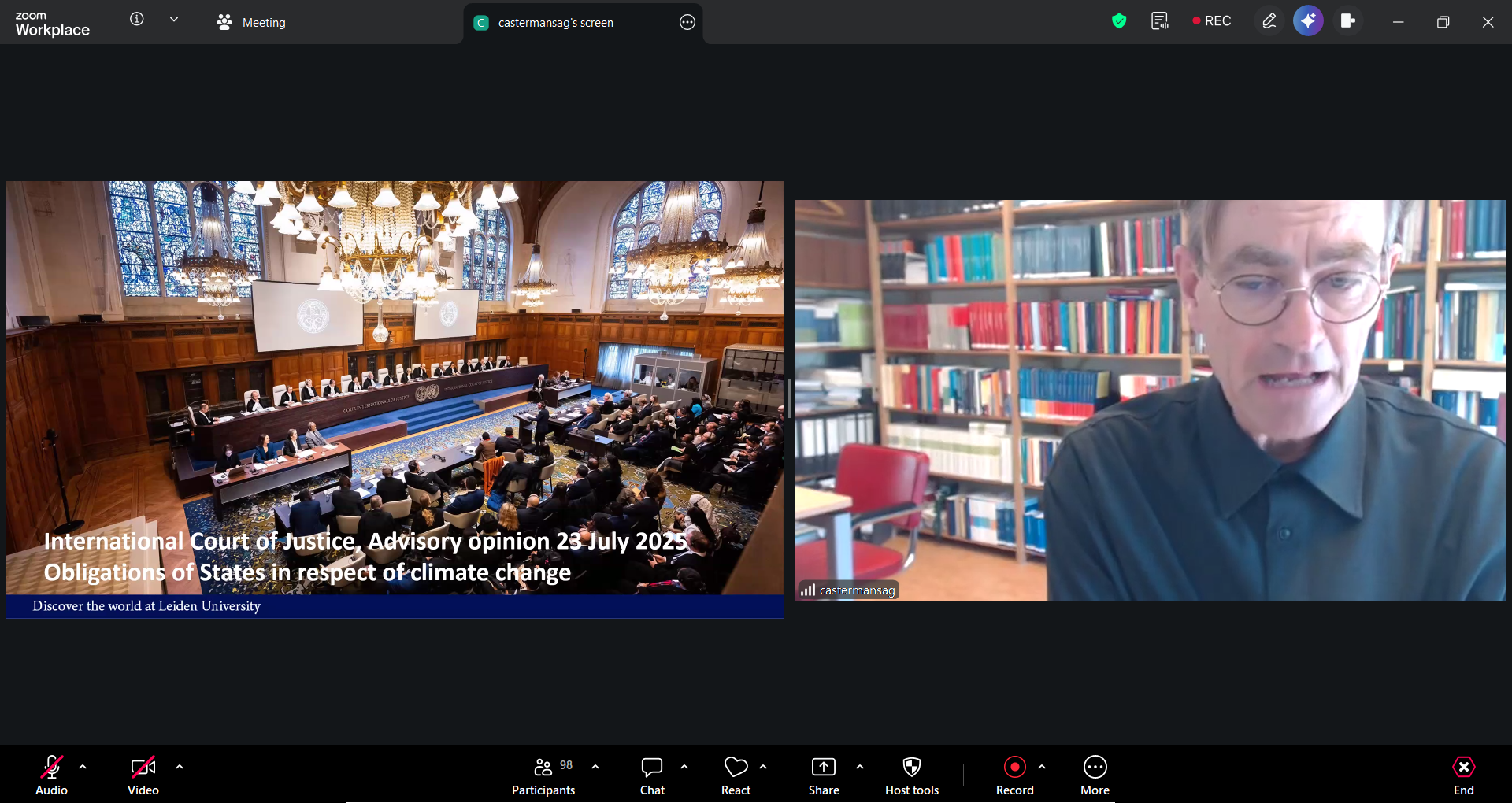
The Faculty of Law at Diponegoro University once again held the Undip Global Classroom (UGC), featuring Prof. Dr. Alex Geert Castermans from Leiden University as the keynote speaker. The session, themed “The Obligation of Companies to Prevent Global Warming and the Choice of Remedies,” featured Rahandy Rizki Prananda, S.H., M.H., as the discussant.
Held on Tuesday, April 21, 2026, the event highlighted recent developments in private international law, particularly the expansion of the duty of care concept to address the climate change crisis. According to the official invitation, the forum was designed as an academic space to explore the responsibilities of states and corporations in the increasingly complex context of global warming.
In his presentation, Prof. Castermans emphasized that climate change can no longer be understood solely as a public policy issue, but has evolved into a legal issue that directly impacts human rights. The material presented demonstrated the close relationship among climate change, tort law, and human rights, particularly by recognizing that climate change can disrupt fundamental rights, such as the right to life and the right to privacy and family life.
One important point raised was the growing positive obligation of states to take concrete steps to reduce greenhouse gas emissions. This is reflected in developments in international jurisprudence, including the European Court of Human Rights’ ruling, which affirmed that states have an obligation to reduce emissions to protect citizens’ rights progressively.
However, the discussion did not stop at state responsibility. Prof. Castermans pointed out that legal developments are also beginning to recognize corporate responsibility, particularly through the concept of duty of care in civil law. In this context, companies can no longer hide behind the absence of explicit regulations, as unwritten standards of social decency can serve as a basis for assessing their legal obligations.
Landmark cases such as Urgenda v. State of the Netherlands and Milieudefensie v. Shell illustrate how courts are beginning to interpret the legal obligation to reduce emissions as a legal responsibility rather than merely a moral commitment. One ruling even emphasized that companies have an obligation to help prevent dangerous climate change, even though this obligation is not explicitly stipulated in positive law.
Interestingly, the discussion also highlighted the limitations of the current legal approach. While there is a trend toward recognizing a general obligation for companies to reduce emissions, courts still face difficulties in establishing concrete quantitative standards, such as the percentage of emissions reductions that individual companies must meet.
Furthermore, the role of soft law instruments such as the UN Guiding Principles on Business and Human Rights and the OECD Guidelines was discussed as increasingly influential normative sources in shaping standards of corporate obligations. Although not formally binding, these instruments have been used by courts as references in interpreting corporate legal obligations.
Through this session, the Faculty of Law at Diponegoro University not only broadened students’ understanding of global legal developments but also emphasized the importance of an interdisciplinary approach to addressing climate change. The evolving discourse suggests that the future of law can no longer be separated from global challenges, as the boundaries between public and private law are increasingly blurred in efforts to protect the common good.