

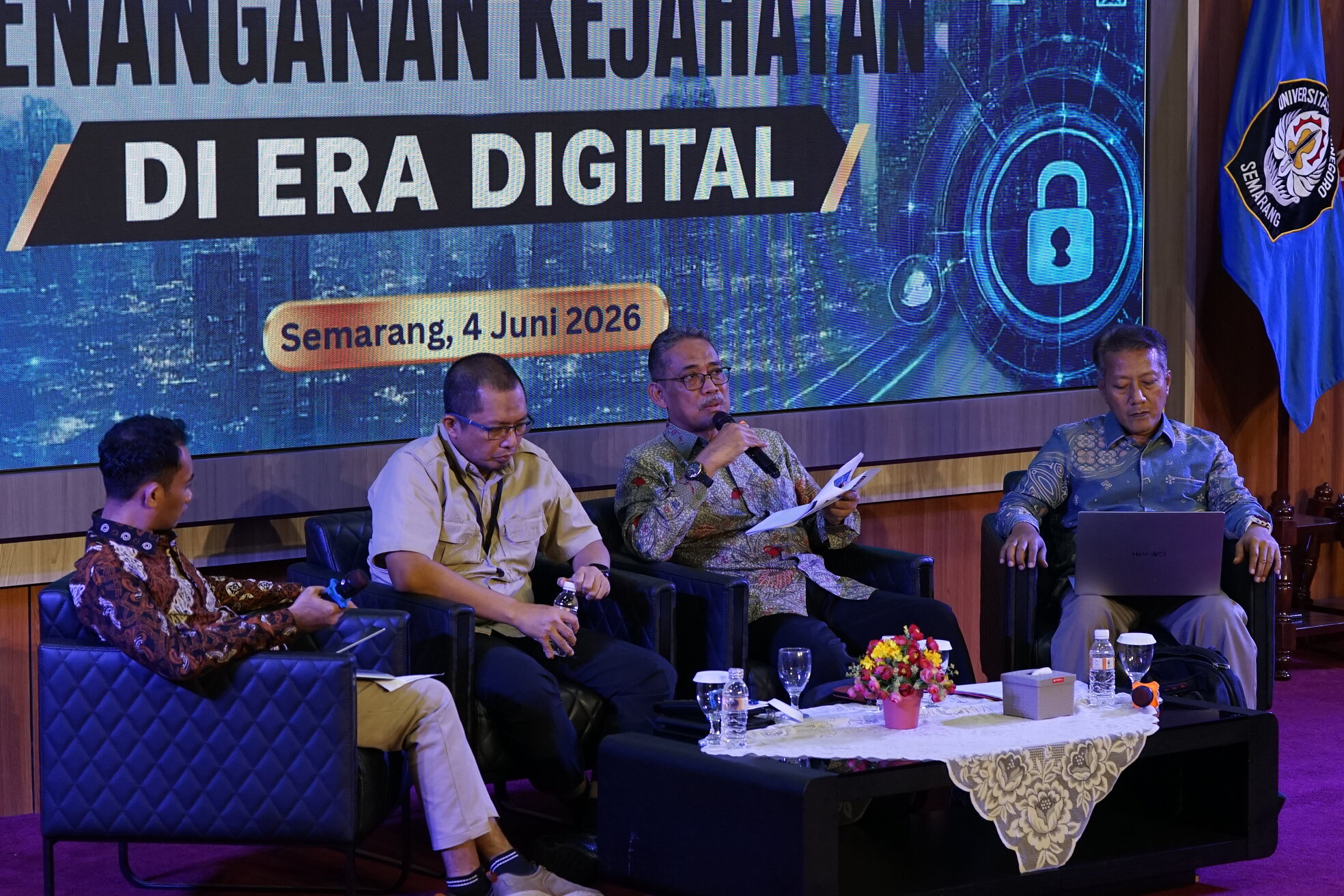
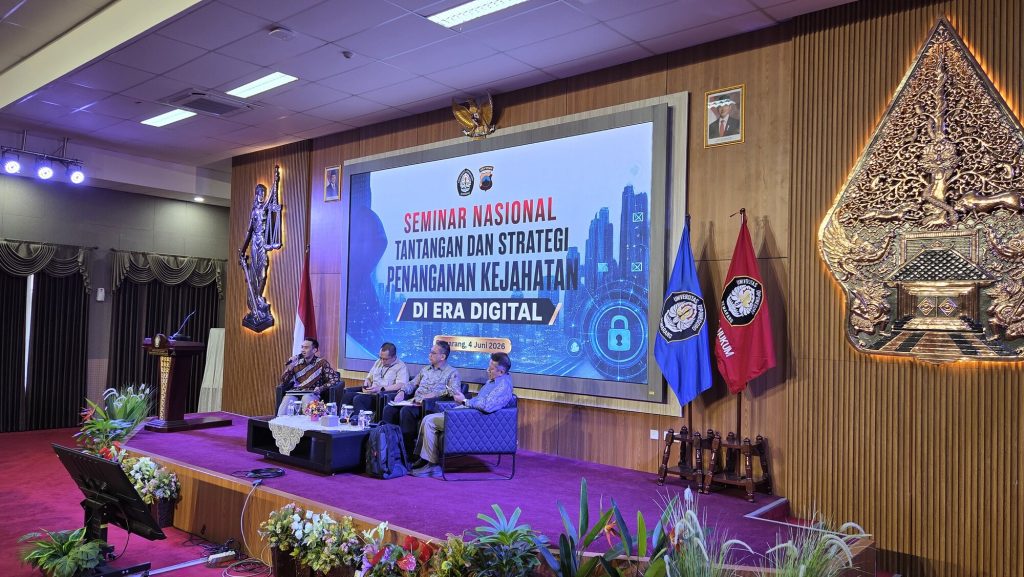
Semarang, June 4, 2026 — The Faculty of Law, Universitas Diponegoro, through the Center for Police Studies, in collaboration with the Central Java Regional Police, held a National Seminar entitled “Challenges and Strategies for Handling Crime in the Digital Era” on Thursday, June 4, 2026. The event took place in the Fiat Justisia Room, Prof. Samiadji Suryocaroko Building, Universitas Diponegoro’s Faculty of Law, and was attended by 667 participants, both offline and online. The seminar brought together a diverse group of people, including academics, students, law enforcement officers, and the general public. The event provided a forum for discussion of the development of digital crime from various perspectives, including law enforcement, criminal law reform, personal data protection, and protection for victims of digital crime.
The event began with remarks from the Head of the Universitas Diponegoro Research and Development Institute (LPPM), Prof. Dr. Ing. Ir. Suherman, S.T., M.T.; the Vice Rector for Human Resources, Information Technology, Law, and Organization, Prof. Dr. Adian Fachtur Rochim, S.T., M.T., and the Director of Community Development of the Central Java Regional Police, Senior Commissioner Siti Rondijah, S.Si., M.Kes. In his remarks, Prof. Adian stated that the development of digital technology has brought numerous benefits to society. Information technology facilitates communication, accelerates service delivery, and opens new opportunities across various fields. However, the digital space has also given rise to new, increasingly complex forms of crime that no longer recognize territorial boundaries.
The seminar also featured Commissioner General of Police Prof. Dr. Chryshnanda Dwilaksana, M.Si., Head of the National Police Transformation and Reform Team, as the keynote speaker. In his presentation, he emphasized that crime in the digital era moves rapidly, crosses regions, and is often difficult to detect directly. Therefore, law enforcement officers need to adapt to technological developments and changing crime modes continuously.
In the presentation session, the Director of Cyber Investigation of the Central Java Regional Police, Senior Commissioner of Police Himawan Sutanto Saragih, S.H., S.I.K., S.T., M.H., explained that cybercrime has undergone significant changes. Crimes that were previously conventional have now evolved into those based on advanced technology, including those that utilize artificial intelligence, automation, and cross-border networks. According to Senior Commissioner of Police Himawan, various modes of attack, such as phishing, online fraud, data breaches, deepfakes, and AI scams, pose new challenges that must be addressed together. Combating cybercrime cannot be done only through a repressive approach; it also needs to be accompanied by strengthening digital literacy and protection.
Meanwhile, Professor of Criminal Law at the Faculty of Law, Universitas Diponegoro (Undip) and the Drafter of the National Criminal Code, Prof. Dr. Pujiyono, S.H., M.Hum., discussed the design of the National Criminal Code in response to digital crime. Prof. Pujiyono highlighted the importance of harmonization between the National Criminal Code and laws and regulations related to information technology. He emphasized that rapid technological developments demand legal certainty through strengthening the regulation of electronic evidence, adjusting digital terminology, and adapting regulations to technological developments. This is crucial so that national criminal law can better respond to evolving forms of digital crime.
The perspective of victim protection was presented by Dr. Edmon Makarim, S.Kom., S.H., LL.M., an expert in Digital Law and Informatics from the Faculty of Law, University of Indonesia. In his presentation, Dr. Edmon emphasized that personal data protection should not only focus on administrative compliance but also on restoring victims’ rights. Dr. Edmon explained that victims of personal data misuse not only suffer economic losses but can also experience psychological harm, loss of privacy, and threats to their identity and dignity as human beings. Therefore, victim protection must be a primary concern in handling digital crime.
The discussion, moderated by Dr. Muh. Afif Mahfud, S.H., M.H., was lively. Participants raised a variety of questions, ranging from handling cybercrime cases to the role of the police in prevention, the effectiveness of digital crime regulations, and the readiness of national law to address the development of artificial intelligence. The Head of the Center for Police Studies at Universitas Diponegoro, Prof. Dr. Ani Purwanti, S.H., M.Hum., stated that this seminar provided an important platform for bringing together academic perspectives and law enforcement practices. She emphasized that digital crime must be addressed through an integrated approach, including strengthening regulations, enhancing officers’ capacity, and increasing public digital literacy. Throughout the seminar, the speakers emphasized the importance of synergy between the government, law enforcement officials, universities, the private sector, and the community. Handling digital crime cannot be done reactively; it must also be directed at prevention efforts and strengthening digital resilience.
In closing, the seminar produced several strategic recommendations, including strengthening public digital literacy, increasing law enforcement officers’ capacity in digital forensics and cyber investigation, strengthening the accountability of Electronic System Operators, and building integrated national cyber resilience. These recommendations are expected to serve as academic contributions in supporting efforts to combat digital crime and protect public rights in the era of digital transformation. Through this activity, the Faculty of Law Undip reaffirmed its commitment to continue encouraging collaboration among the academic world, law enforcement officers, and the public to build a safe, just, and trustworthy digital space.