
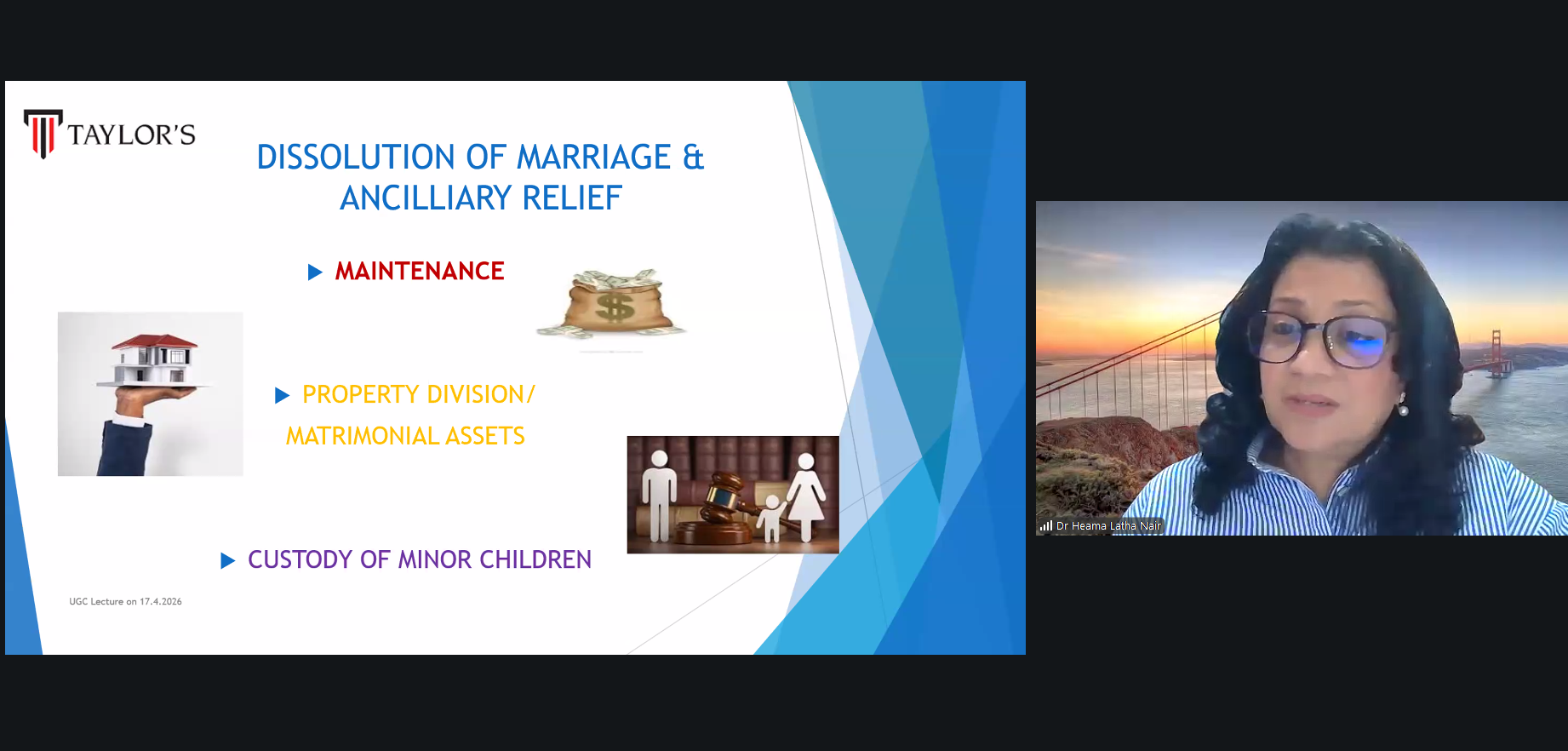
The Faculty of Law at Diponegoro University continues its Undip Global Classroom (UGC) 2026 series by presenting Dr. Heama Latha A/P Narayan from Taylor’s University, Malaysia, as the keynote speaker. This session addressed the topic “Protection of Women in Divorce and Economic Security: Legal Solvent Practice in Malaysia,” with Bunga Jasmine Puji Hapsari, S.H., M.Kn. as the discussant.
In her presentation, Dr. Heama Latha emphasized that women’s protection in the context of divorce cannot be separated from the structure of the prevailing legal system. Malaysia, as a country with a dual legal system, distinguishes between the family law regimes of non-Muslims, who are subject to civil law, and Muslims, who are under the jurisdiction of Sharia law.
The main focus of the discussion was the legal framework for non-Muslims, particularly the Law Reform (Marriage and Divorce) Act 1976 (LRA) and the Married Women and Children (Maintenance) Act 1950. These two instruments provide the legal basis for women to obtain economic security, both during marriage, during divorce proceedings, and after the dissolution of the marriage.
One of the central issues raised was the concept of maintenance, understood not only as the fulfillment of basic needs but also as a decent standard of living, commensurate with the economic circumstances of the parties. Determining the amount of maintenance is not automatic. Still, it depends on several factors, including the requesting party’s needs, the dependent party’s financial capacity, and each party’s contributions to the household.
Interestingly, trends in Malaysian court decisions indicate a shift in approach. The right to maintenance is no longer viewed as an automatic entitlement for the wife. Still, it is instead assessed contextually based on concrete circumstances, including the woman’s own economic capacity. In several recent decisions, courts have even rejected maintenance claims if the wife is deemed financially independent.
In addition to maintenance, the discussion also covers the division of matrimonial assets. Significant changes occurred through the 2017 amendment to the LRA, which recognized non-financial contributions, such as domestic roles within the household, as a basis for dividing assets. This approach encourages a more equitable distribution, even approaching the principle of equality of division, while considering substantive justice for both parties.
However, Dr. Heama Latha also highlighted serious challenges in practice, particularly in enforcing court decisions. Issues such as non-compliance with maintenance payments, concealment of assets, and lengthy and expensive legal processes remain significant obstacles to ensuring effective protection for women after divorce.
The evolving discussion demonstrated that despite a comprehensive legal framework, the effectiveness of protection depends heavily on its implementation and enforcement. This also opened up space for comparative reflection in the Indonesian context, particularly in formulating policies that are not only normative but also responsive to social realities.
Through this session, the Faculty of Law at Diponegoro University reaffirmed its commitment to presenting legal discourse that is not only theoretical but also oriented towards practice and global dynamics.