

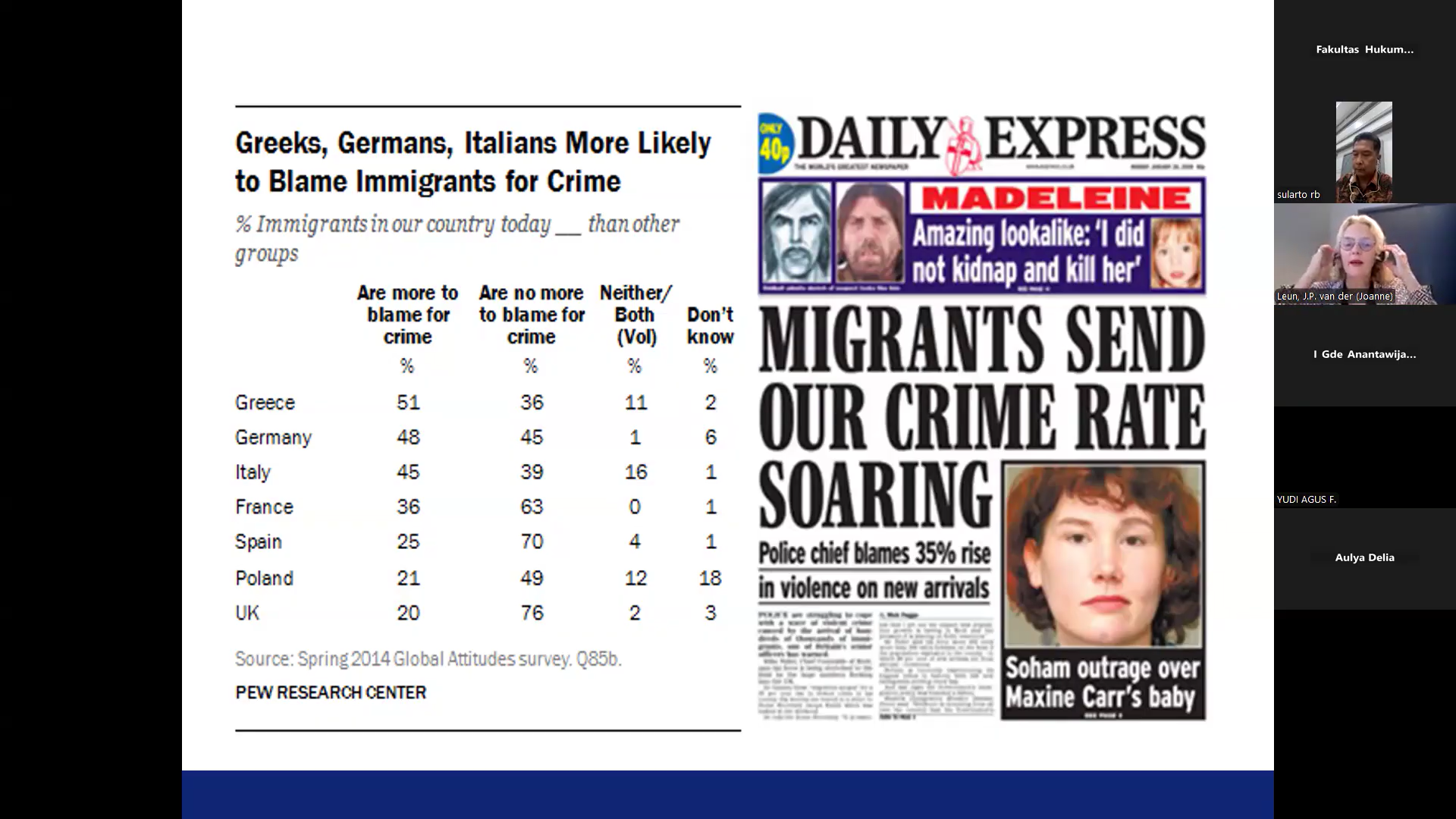
Cross-border human mobility involves not only immigration issues but also criminal law enforcement policies and the protection of human rights. The intersection of these two legal domains has become a critical subject in contemporary criminological studies.
The Faculty of Law at Universitas Diponegoro addressed this topic through an “Undip Global Classroom” (UGC) session held on Tuesday, October 6, 2026, at 3:00 PM Western Indonesian Time (WIB). The online lecture, titled “Studying Criminology and Migration: A Criminological Perspective,” featured Prof. Joanne van der Leun from Leiden University, the Netherlands, with Dr. R.B. Sularto, S.H., M.Hum., serving as a discussant.
Prof. Van der Leun is a professor of criminology whose work focuses on the nexus between migration policy, criminal policy, and human trafficking. She also served as the Dean of the Faculty of Law at Leiden University from 2016 to 2023.
The lecture explored the concept of “crimmigration”—a term coined by Juliet Stumpf in 2006 to describe the deepening integration of criminal law and immigration law. This phenomenon is evident in the criminalization of immigration violations, as well as the application of immigration-related consequences—such as deportation—to individuals who have committed criminal offenses.
The analysis highlights the importance of distinguishing an individual’s migration status from their involvement in criminal activity. The relationship between migration and crime cannot be inferred solely from citizenship status or law enforcement statistics. Crime data must be interpreted with careful consideration of recording policies, social conditions, and actual law enforcement practices.
The lecture also covered human trafficking and the smuggling of migrants. It emphasized the necessity of distinguishing between the two, noting that exploitation is a central element of human trafficking. Restrictive migration policies can also lead to unintended consequences, including an increased vulnerability to exploitation among individuals with precarious immigration or employment status.
A victimological perspective complements this analysis by examining victims’ circumstances, their access to protection, and their capacity to make choices within constrained situations. This approach helps explain why criminal law enforcement alone is insufficient to address the issue of human trafficking. The relevance of this theme to legal education in Indonesia lies in the need to interpret criminal and immigration policies within their broader social context. Through UGC (Undergraduate Course/Curriculum), students have the opportunity to explore a criminological approach that integrates human protection and the empirical evaluation of policies into the study of law.