

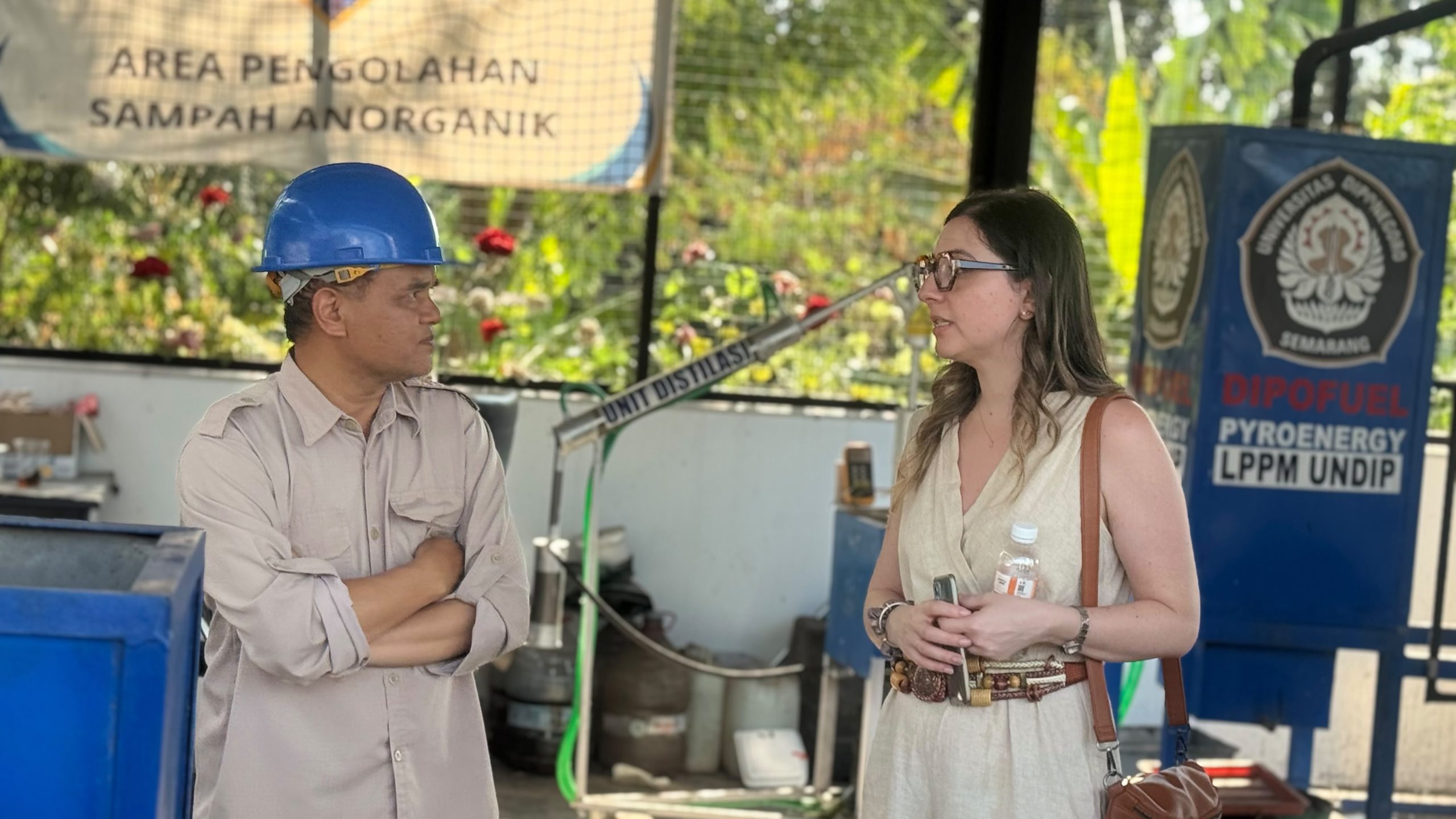
Semarang, July 20, 2026 – The Faculty of Law at Universitas Diponegoro (FH Undip) organized a “Campus Tour and Visit to the Integrated Waste Processing Facility (TPST)” on Monday, July 20, 2026. This event was part of an academic collaboration involving a visiting professor/lecturer, Dr. Panagiota Kotzamani from the University of Sheffield. Participants included the international guest and the leadership and academic community of the Faculty of Law. The event aimed to showcase the university’s outstanding facilities and demonstrate Universitas Diponegoro’s commitment to realizing a “Sustainable Campus” through sustainable environmental management.
The program began with a campus tour that introduced various academic and support facilities at Universitas Diponegoro, followed by a visit to the university’s Integrated Waste Processing Facility (TPST). During the visit, participants received an explanation of the integrated waste management system implemented at Undip, covering the entire process—from sorting, collection, and processing to the repurposing of waste into valuable products. The management team explained that Universitas Diponegoro currently handles approximately 1.33 tons of waste daily, generated by various faculties, work units, and academic community activities. To support these operations, the TPST is equipped with modern facilities, including plastic shredders, leaf and twig choppers, pyrolysis units, distillation units, cooling systems, compost sieves, charcoal pulverizers, charcoal briquette makers, and biomass incinerators. These technologies are utilized to process organic waste into compost, organic fertilizer, and charcoal briquettes. In contrast, inorganic waste is processed into raw materials for recycling, thereby reducing the volume of waste sent to final disposal sites (TPA).
This activity served as a learning opportunity regarding the importance of applying the “reduce, reuse, recycle” (3R) principles within campus life. Participants not only gained insight into the waste-processing technology implemented at Universitas Diponegoro but also discussed the importance of the entire academic community’s participation in fostering an environmentally conscious culture, as well as opportunities for international collaboration in developing sustainable waste-management innovations. The integrated waste management system implemented at Universitas Diponegoro represents a tangible step toward achieving the Sustainable Development Goals (SDGs)—specifically SDG 11 (Sustainable Cities and Communities), SDG 12 (Responsible Consumption and Production), SDG 13 (Climate Action), and SDG 17 (Partnerships for the Goals). Through the campus tour and visit to the Integrated Waste Processing Facility, the Faculty of Law at Universitas Diponegoro not only showcased the excellence of its campus facilities to international partners but also demonstrated the university’s commitment to integrating sustainability values into the implementation of the “Tridarma” (the three pillars of higher education). It is hoped that this activity will further strengthen international cooperation networks while serving as a platform for the exchange of knowledge and best practices in innovative, sustainable, and impactful environmental management.