

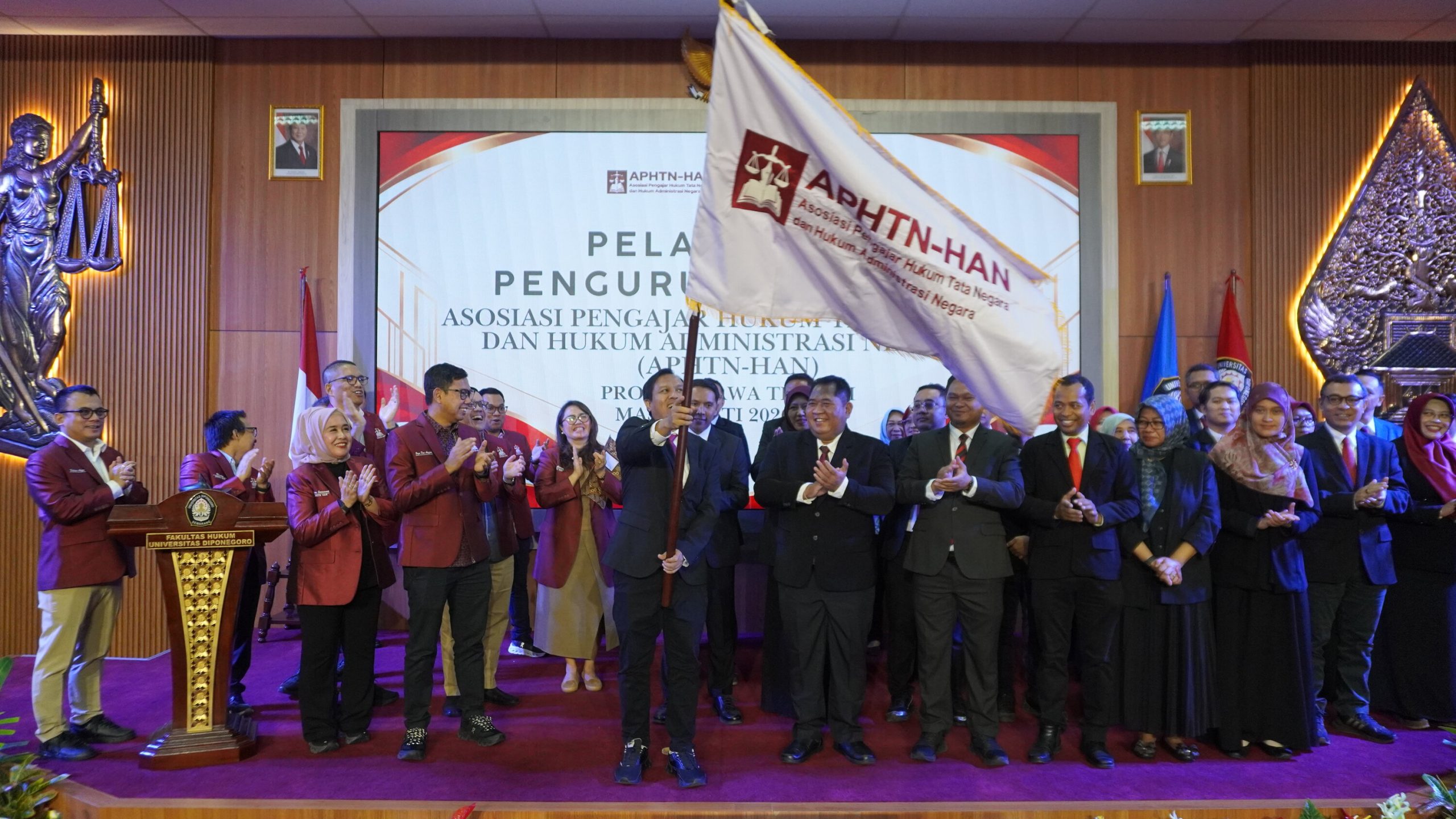
Semarang, September 12, 2026 — The Faculty of Law at Universitas Diponegoro (FH Undip) hosted a national seminar titled “Limited Citizenship Policy as a Means to Encourage Diaspora Talent to Return to Indonesia.” The event was held in conjunction with the inauguration of the Central Java regional board of the Association of Constitutional and Administrative Law Lecturers (APHTN-HAN) for the 2026–2031 term, on Saturday (September 12).
The event took place in the Fiat Justisia Room at the Faculty of Law, Universitas Diponegoro, Semarang. This national seminar was organized in collaboration among Universitas Diponegoro, APHTN-HAN, and the Expert Body of the House of Representatives of the Republic of Indonesia (BKD DPR RI).
Prof. Dr. Guntur Hamzah, S.H., M.H., served as the keynote speaker. The discussion featured insights from panelists Prof. Dr. Agus Riwanto, S.H., M.H., Dr. Oce Madril, S.H., M.A., and Dr. Amalia Diamantina, S.H., M.Hum.
Addressing the Direction of Citizenship Policy for Diaspora Talent
The seminar explored the discourse surrounding a “limited citizenship” or “limited dual citizenship” policy, aimed at creating opportunities for Indonesian diaspora members—who possess strategic talents and competencies—to return and contribute to national development.
This discourse is linked to proposed amendments to Law Number 12 of 2006 concerning Citizenship of the Republic of Indonesia. One of the underlying issues of concern involves members of the Indonesian diaspora who, in the course of their education, careers, or international service, have chosen—or were compelled—to relinquish their Indonesian citizenship.
In this context, a policy on “limited citizenship” must consider the balance between global access and national ties. The evolution of global talent mobility necessitates the formulation of a policy that maintains connections between individuals and Indonesia while creating space for the diaspora to contribute to national development.
This policy discourse is also aligned with the government’s perspective that Indonesia’s brightest individuals should not be forced to choose among developing their capacities, pursuing careers on the global stage, and maintaining their bond with their homeland.
The concept of limited citizenship currently being proposed is not intended for general application. Instead, it is designed with greater specificity, taking into account the nation’s strategic needs—particularly in sectors that contribute significantly to national development.
Targeted areas include scientists, researchers, and academics; experts in artificial intelligence (AI) and fields within science, technology, engineering, and mathematics (STEM); professional physicians and engineers; and internationally accomplished artists and athletes.
Several principles must be considered in the policy’s formulation. First, the policy must be implemented selectively and in a measured manner, based on the country’s specific needs. Second, a robust verification and integrity-testing mechanism is required for prospective recipients of limited citizenship status. Third, national security and the state’s interests must be central to the definition of the rights and obligations of those granted this status.
The discussion also touched upon the progress of regulatory development. An academic paper and a draft for regulatory amendments concerning citizenship have been prepared by the Ministry of Law, which will subsequently be deliberated with the House of Representatives of the Republic of Indonesia.
Inauguration of the Central Java Regional Board of APHTN-HAN
In addition to a national seminar, the event also included the inauguration of the Central Java Regional Board of APHTN-HAN for the 2026–2031 term.
APHTN-HAN serves as a platform established to foster, maintain, and strengthen ties among lecturers of Constitutional Law and Administrative Law across Indonesia. The organization is also dedicated to enhancing the quality of its members and advancing academic study and curriculum in Constitutional Law and Administrative Law.
APHTN-HAN maintains both a central governing body and regional boards. The inauguration of the Central Java Regional Board for the 2026–2031 term is part of efforts to strengthen the organization and solidify the academic network among Constitutional Law and Administrative Law lecturers in the region.
During the inauguration, Prof. Dr. Agus Riwanto, S.H., M.H., from Universitas Sebelas Maret, was installed as the Regional Chair. The position of Vice Chair was entrusted to Dr. Kadek Cahya Susila Wibawa, S.H., M.H., from Universitas Diponegoro. Furthermore, Prof. Dr. Tedi Sudrajat, S.H., M.H., from Universitas Jenderal Soedirman, was appointed as Secretary, with Muhamad Azhar, S.H., LL.M., from Universitas Diponegoro, serving as Deputy Secretary.
This inauguration serves as a pivotal moment to bolster APHTN-HAN Central Java’s role as a hub for communication, collaboration, and academic development for lecturers in Constitutional Law and Administrative Law. Through this series of events—comprising a national seminar and the board inauguration—the gathering served as a forum for discussing developments in citizenship policy while strengthening academic networks and fostering collaboration among lecturers in Constitutional Law and Administrative Law. This academic forum is expected to contribute to the development of legal studies and provide an academic perspective for the formulation of public policy and legislation in Indonesia.