

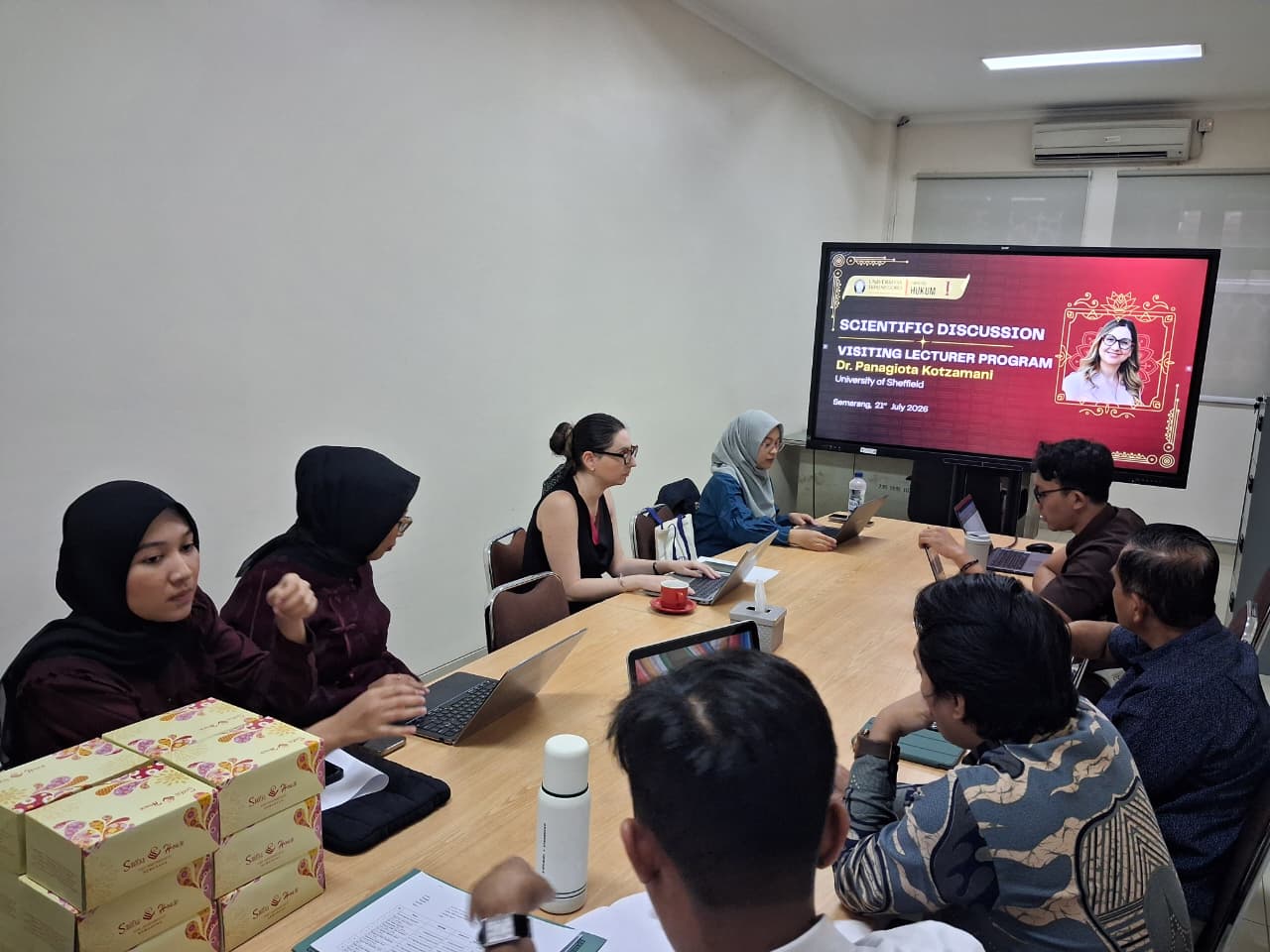
Semarang, July 21, 2026 – The Faculty of Law at Universitas Diponegoro (FH Undip) hosted an Expert Seminar and Faculty Roundtable on Tuesday, July 21, 2026, in the Main Meeting Room of the Prof. Satjipto Rahardjo, S.H. Building. This event was part of an academic collaboration series featuring a visiting professor/lecturer, Dr. Panagiota Kotzamani, from the School of Law at the University of Sheffield. Held from 09:00 to 12:00 WIB, the event was attended by faculty leadership, heads of departments and study programs, lecturers, and the academic community of the Faculty of Law at Universitas Diponegoro. The seminar served as a platform for exchanging ideas on the latest developments in Business and Human Rights (BHR) while strengthening international academic collaboration regarding issues of just energy transition and human rights-based corporate governance.
During the seminar session, Dr. Panagiota Kotzamani presented a topic titled “Universality, Participation and Just Green Energy Transitions: From Global Business & Human Rights Treaty-Making to Energy Justice and Corporate Due Diligence.” She explained that the universality of human rights within the Business and Human Rights regime must be established through a norm-making process that is inclusive, participatory, and respectful of diverse perspectives. By combining the Policy-Oriented Jurisprudence approach (New Haven School) with Habermasian Discourse Ethics, Dr. Kotzamani emphasized that legal legitimacy is determined not only by the substance of norms but also by a dialogic process involving all affected parties. Furthermore, she reviewed the progress of the Business and Human Rights Treaty through the Open-Ended Intergovernmental Working Group (OEIGWG) process. She highlighted the importance of implementing Human Rights Due Diligence (HRDD) as a tool for companies to identify, prevent, and remedy adverse human rights impacts through active stakeholder engagement.
The discussion then focused on energy justice as the foundation for governing a just green energy transition. Dr. Kotzamani explained that the transition to low-carbon energy focuses not only on efficiency and emissions reductions but also on the equitable distribution of benefits and burdens, public participation, recognition of affected groups, and corporate responsibility. Through the FAIR H₂ research project, she introduced a “Human Rights-Based Governance of Green Energy” framework that integrates energy justice principles with Human Rights Due Diligence (HRDD) mechanisms, serving as a governance model for various clean energy technologies. The event continued with a Faculty Roundtable Discussion exploring opportunities for collaborative research, curriculum strengthening, and the implementation of Business and Human Rights principles and energy justice within sustainable energy regulations.
By hosting the Expert Seminar and Faculty Roundtable, the Faculty of Law at Universitas Diponegoro reaffirmed its commitment to supporting the internationalization of higher education, strengthening collaborative research, and developing legal studies that are responsive to global issues. The event also contributes to the achievement of the Sustainable Development Goals (SDGs), specifically SDG 4 (Quality Education) through enhanced educational quality and international knowledge exchange; SDG 7 (Affordable and Clean Energy) and SDG 13 (Climate Action) through discussions on a just energy transition; SDG 16 (Peace, Justice and Strong Institutions) through the strengthening of human rights-based corporate governance; and SDG 17 (Partnerships for the Goals) through the development of academic cooperation between the Faculty of Law at Universitas Diponegoro and the University of Sheffield. It is hoped that this event will mark the beginning of sustained collaboration in research, scholarly publication, and curriculum development within the fields of Business and Human Rights, corporate governance, and the green energy transition.