
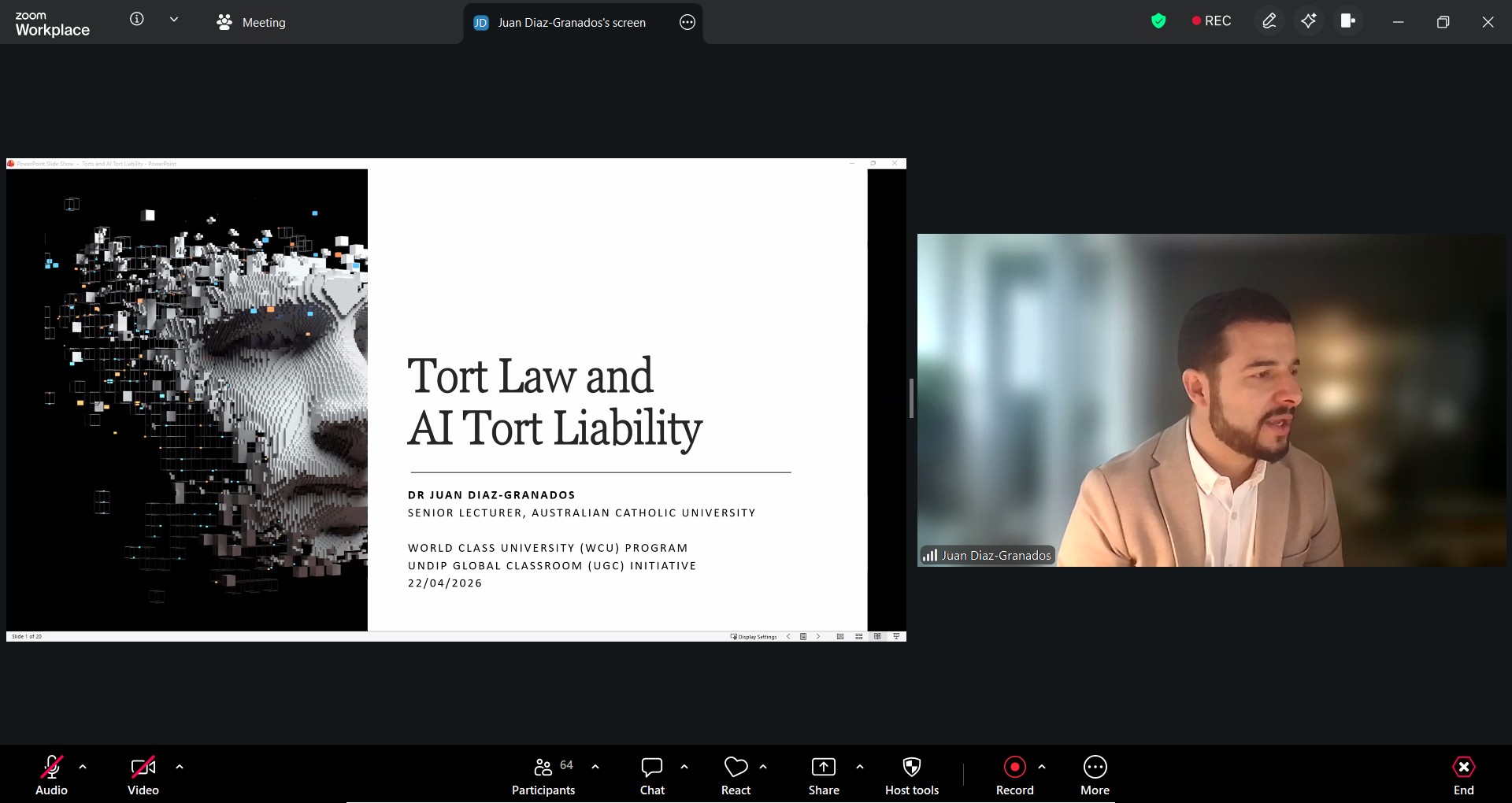
The Faculty of Law at Diponegoro University once again held the Undip Global Classroom (UGC) with Dr. Juan Diaz Granados from Australian Catholic University as the keynote speaker. The event, held on Wednesday, April 22, 2026, raised the theme “AI and Tort Liability: Rethinking, Recalibrating, and Reallocating Risk and Responsibility,” with Rahandy Rizki Prananda, S.H., M.H. as the discussant.
In his presentation, Dr. Granados began by emphasizing that tort law has traditionally been designed to respond to the actions of humans as the primary actors. However, the development of artificial intelligence has fundamentally changed this structure, as decisions are no longer made entirely by humans, but by systems capable of learning, adapting, and acting autonomously.
Tort law itself essentially aims to protect various legal interests, such as personal safety, property, and economic interests, through mechanisms of liability for unlawful acts. The classic model centers on four main elements: duty of care, breach, damage, and causation.
However, when applied to the context of AI, these four elements begin to face serious pressure. One key issue is causality, which becomes increasingly complex due to the involvement of numerous actors in the AI ecosystem, from developers and manufacturers to deployers. Furthermore, the opaque, autonomous, and variable nature of AI makes determining fault and predictability much more difficult.
To address this complexity, Dr. Granados offers a risk-zoning approach, which divides AI use into several categories based on the level of risk and public benefit. In the low-risk category (green zone), a negligence approach is still considered adequate. However, as the risk increases, the legal approach shifts toward a stricter model, even to strict liability in the high-risk category (red zone).
This approach demonstrates a paradigm shift from merely resolving disputes after the loss has occurred (ex post remedy) to a more preventative and risk-management-based arrangement (ex ante governance). Thus, law serves not only as a means of compensation but also as an instrument for controlling technological risks from the outset.
However, this approach also raises critical questions. Reconceptualizing tort law through adjustments to standards of responsibility and risk allocation does offer flexibility. However, it does not fully address fundamental issues related to the distributed and autonomous nature of AI. In this context, the question arises whether tort law can still be the primary instrument for regulating AI liability, or whether it needs to be combined with other legal regimes that are more based on regulation and oversight. Through this discussion, the Faculty of Law at Diponegoro University provides an important space for reflection on the future of law amidst technological developments. The changes brought about by AI not only challenge existing legal doctrine but also force the law to adapt to more fundamental ways of distributing risk and responsibility in the digital age.