
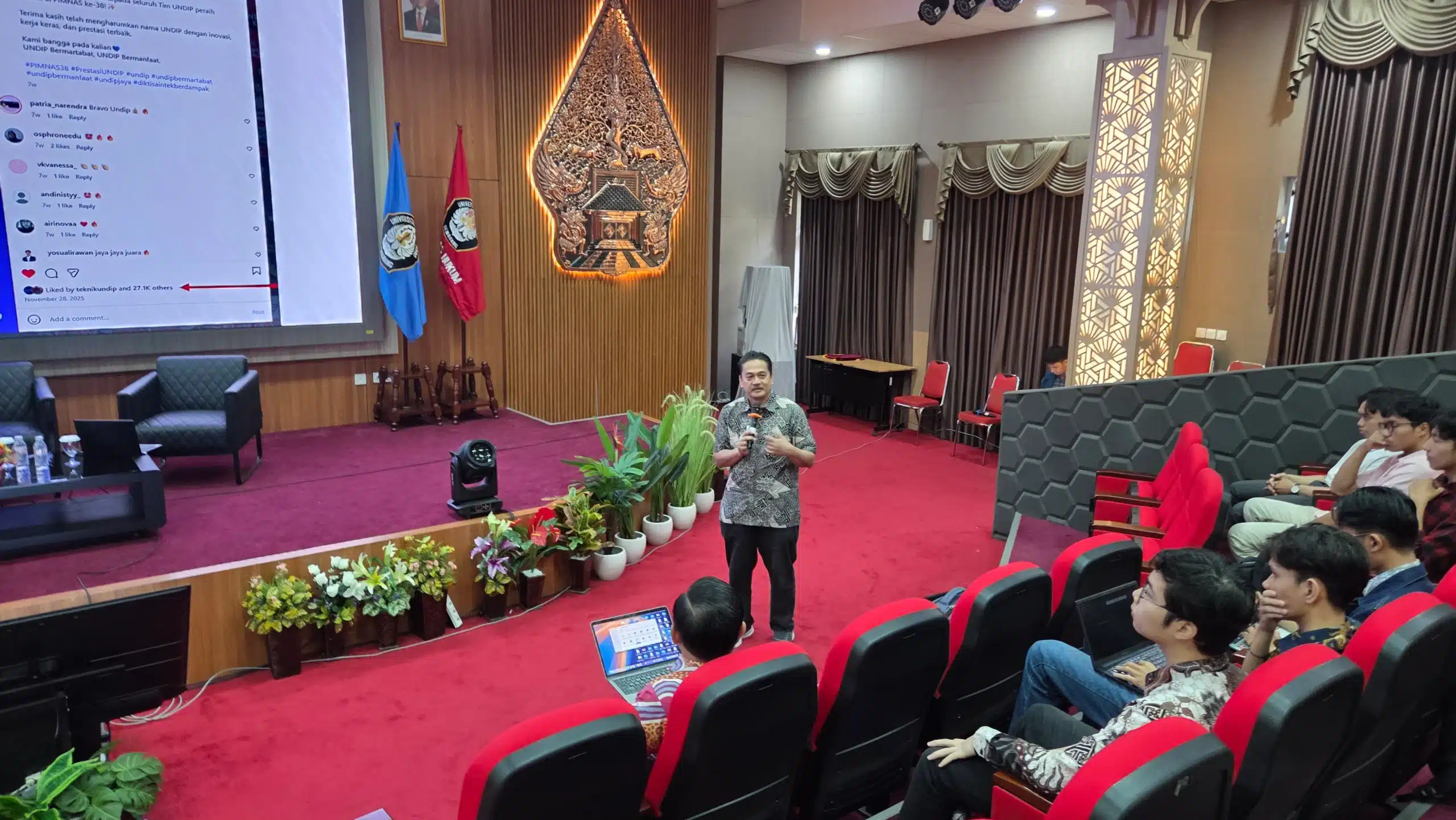
Semarang: The Faculty of Law at Diponegoro University (FH Undip) held a 2026 Student Creativity Program (PKM) Proposal Mentoring Workshop on Thursday, February 12, 2026, in the Fiat Justisia Room. PKM supervisors and student participants attended the event.
The event began with a report from the Vice Dean I for Academic and Student Affairs, Dr. Aditya Yuli Sulistyawan, S.H., M.H. In his report, he stated that, as of the workshop’s opening day, 16 proposals had been submitted by 31 teams. He also highlighted that the Faculty of Law had not yet successfully approved any PKM proposals for funding in 2025. “As we know, PIMNAS is the most prestigious scientific writing competition in Indonesia. Therefore, let’s rise and be enthusiastic about PKM 2026,” he said.
The event was then officially opened by the Dean of the Faculty of Law, Prof. Dr. Retno Saraswati, S.H., M.Hum., Undip. In her remarks, she emphasized the importance of collaboration and strategy in developing PKM proposals. “We must penetrate the collaboration sector. We need to consider potential ideas, writing strategies, and how to incorporate our supervisors’ input effectively. At the Faculty of Law, we are accustomed to competing in the legal field, and this should be a strength,” she said.
The event then continued with the presentation of a plaque to the speaker, Susatyo Nugroho Widy Pramono, S.T., M.M., the Undip PKM Coordinator. The moderator, Muhamad Nafi Uz Zaman, S.H., M.H., introduced the speaker. In his presentation, the speaker played a video of Undip’s journey from preparation to awarding at PIMNAS 2025 and announced that Undip had placed fourth among the Top 10 Winners of PIMNAS 2025.
The speaker also explained that student development in higher education aims to improve achievement, develop soft skills, shape character and ethics, support student welfare, and encourage entrepreneurship. He added that PKM is unique because of its broad scope and variety, multidisciplinary nature, continuous year-round activities, involvement of thousands of students, and numerous awards. Approximately 4,000–5,000 proposals are funded, and 400–500 proposals qualify for PIMNAS.
He also explained the stages of PKM leading to PIMNAS, including proposal selection, proposal funding, PIMNAS qualification, and PIMNAS implementation. The types of PKM include PKM Research (PKM-RE), PKM Social and Humanities Research (PKM-RSH), PKM Community Service (PKM-PM), PKM Entrepreneurship (PKM-K), PKM Application of Science and Technology (PKM-PI), PKM Creative Ideas (PKM-KC), PKM Video Constructive Ideas (PKM-VGK), and PKM Innovative Works (PKM-KI). Furthermore, PKM Written Works are divided into PKM Scientific Articles and PKM Written Futuristic Ideas.
In the next session, the resource person explained the PKM proposal development process and common mistakes. The resource person also reviewed the PKM titles submitted by Undip Faculty of Law students and identified various improvements. The results of this review serve as a reference for students and their supervisors to make improvements in subsequent mentoring sessions.
Through this activity, the quality of Undip Faculty of Law students’ PKM proposals can improve, enabling them to compete for funding and excel at the 2026 PIMNAS event.