
The Faculty of Law at Universitas Diponegoro (FH Undip) held another session of its University Guest Class (UGC) program, featuring Prof. Bongchul Kim from the Hankuk University of Foreign Studies, South Korea, on Tuesday, September 29, 2026, at 1:00 PM WIB. During the session, Prof. Bongchul Kim presented a lecture titled “Korea’s Democratic Resilience as a Digital Middle Power.”
In his presentation, Prof. Bongchul Kim explored how the development of digital technology and interpersonal communication has strengthened South Korea’s democratic resilience. He explained the concept of a “digital middle power”—a nation that, while not necessarily a dominant global superpower, is nonetheless capable of exerting influence through its digital capacity, technological innovation, and data-driven governance.
Furthermore, Prof. Bongchul Kim cited the declaration of martial law in South Korea on December 3, 2024, as a case study to illustrate the role of digital communication in navigating a political crisis. Amidst restrictions on political activity, public demonstrations, and the dissemination of information through traditional media and publications, citizens turned to alternative communication channels.
Using mobile phones, messaging apps, and social media, the public shared information, photographs, and videos from the ground. This rapid exchange of information helped the public develop a shared understanding of the unfolding situation and stay informed about the constitutional processes underway in South Korea’s National Assembly.
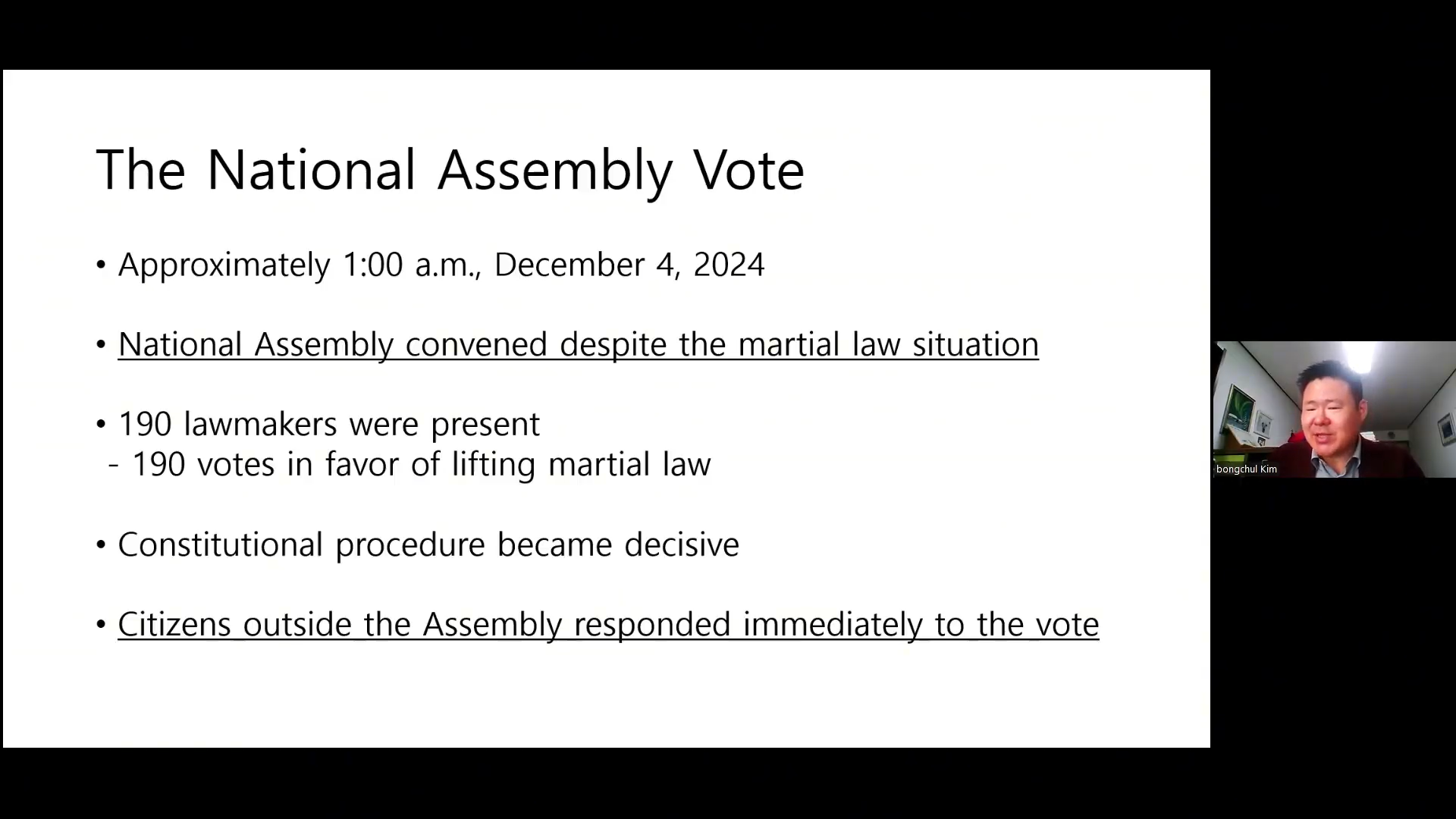
Prof. Bongchul Kim also examined the connection between public communication and the actions of democratic institutions. In this instance, digital communication enabled the public to understand the role of the National Assembly and the progress of the vote to lift martial law. At approximately 1:00 AM on December 4, 2024, 190 members of parliament were present and voted unanimously to revoke the martial law declaration.
Through this case study, Prof. Bongchul Kim emphasized that digital communication can accelerate the dissemination of information, raise public awareness, and facilitate civic participation. Nevertheless, the resilience of democracy still relies on the role of constitutional institutions and a public that is accurately informed. Verifying information is also crucial, especially given the rapid flow of digital communication.
This UGC (University Global Classroom) activity offers a comparative perspective on the relationship between digital technology, civic participation, and the resilience of democracy. Through discussions with international academics, the Faculty of Law at Universitas Diponegoro (FH Undip) continues to broaden the academic community’s understanding of legal issues and global developments relevant to contemporary democratic life.