
Semarang, September 11, 2026 – The Faculty of Law at Universitas Diponegoro (FH Undip) held another University Guest Class (UGC) session, featuring Dr. Sherin Kunhibava, a Senior Lecturer from the Faculty of Law at Universiti Malaya, Malaysia. The session took place on Friday (September 11, 2026) at 13:30 WIB via Zoom. Centered on the theme “Regulating Fintech (Conventional and Sharia): Lessons Learned from Malaysia to Indonesia,” the discussion explored the evolution of regulations for both conventional and Sharia-based financial technology (fintech), offering a comparative perspective between Malaysia and Indonesia.
In her presentation, Dr. Sherin Kunhibava explained that financial technology (fintech) refers to the use of technology to deliver financial services and products to the public. The growth of fintech has driven the transformation of various financial service sectors, ranging from banking, insurance, and investment to digital payments and technology-based financing.
Furthermore, she outlined the fintech regulatory framework in Malaysia, which comprises two primary authorities: Bank Negara Malaysia (BNM)—the central bank that oversees the banking and financial services sector—and the Securities Commission Malaysia (SC), which is responsible for regulating and supervising the capital market. Both institutions possess distinct mandates and regulatory approaches for accommodating the development of digital financial innovations.
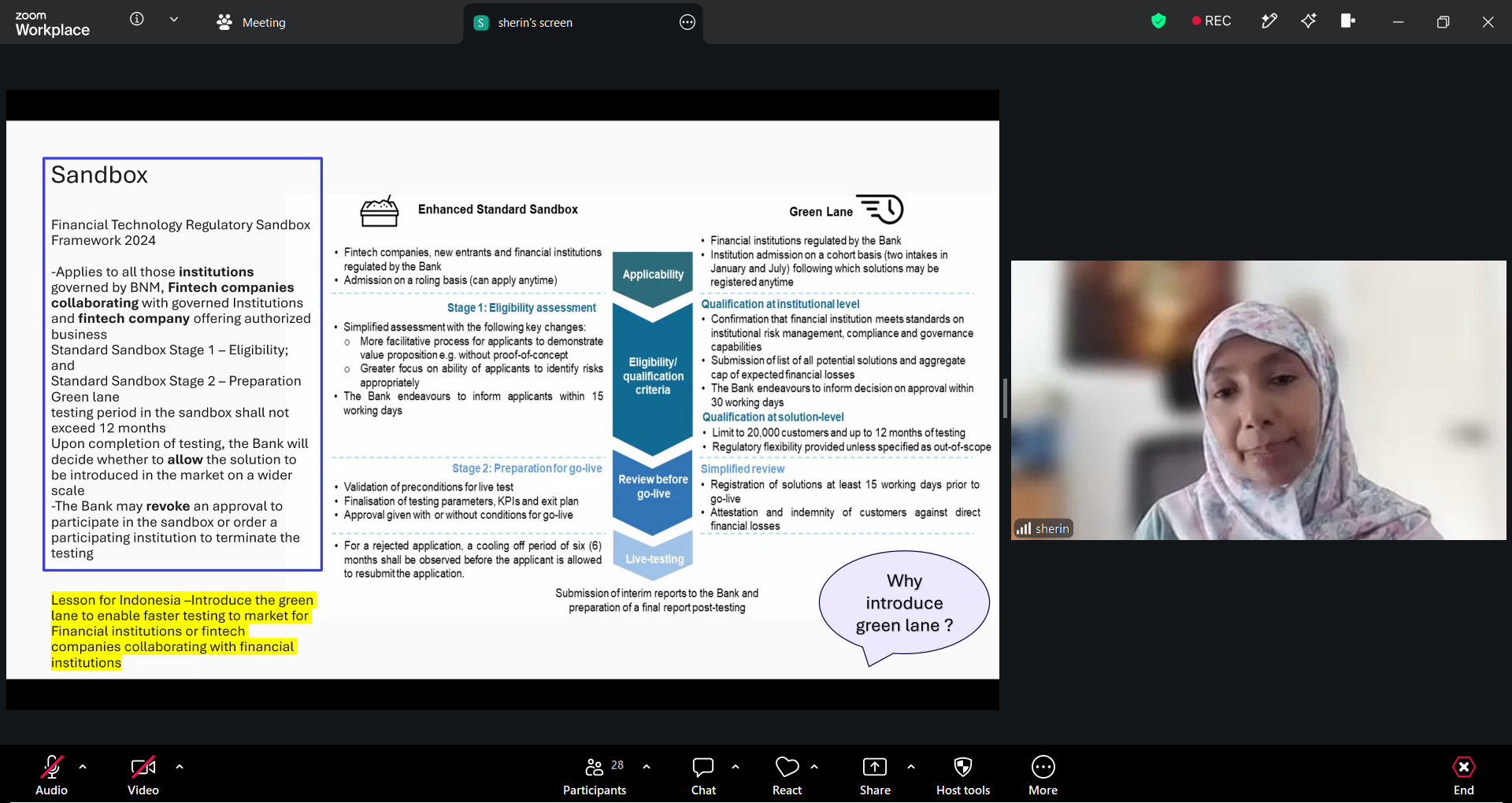
A notable aspect discussed was the Sharia oversight mechanism within Malaysia’s financial industry, facilitated by the Shariah Advisory Councils at both BNM and the Securities Commission. These councils play a pivotal role in defining the application of Sharia principles to financial activities and providing guidance on Sharia-related matters within the financial services sector. This model offers valuable insights for Indonesia as it seeks to strengthen the governance and legal certainty of its Sharia financial sector. The discussion then moved on to various fintech regulations in Malaysia, including those governing electronic Know Your Customer (e-KYC) processes, electronic money (e-money), digital banking, and “Buy Now, Pay Later” (BNPL) services. Dr. Sherin also explained the implementation of the Financial Technology Regulatory Sandbox Framework, a mechanism for testing financial innovations before they are deployed more broadly in the market. This approach provides space for the development of financial technology while ensuring that oversight, risk management, and consumer protection remain key priorities.
Beyond the banking sector, the presentation covered fintech regulations under the purview of the Securities Commission Malaysia, such as equity crowdfunding, peer-to-peer financing, digital assets, Initial Exchange Offerings (IEOs), and robo-advisory services. These instruments illustrate how Malaysia has developed a regulatory framework to accommodate innovation within the capital market and digital investment landscape.
By drawing comparisons with Indonesia’s regulatory environment, Dr. Sherin identified several lessons that could inform the development of national policy. These include strengthening fintech oversight mechanisms, refining regulations for digital financial services, and developing frameworks for consumer protection and Sharia-compliant governance.
This University Guest Lecture (UGL) is part of the Faculty of Law at Universitas Diponegoro (FH Undip )’s efforts to broaden students’ academic horizons through knowledge exchange with international scholars. The discussion of both conventional and Sharia-based fintech regulations is intended to foster a critical understanding of legal challenges in the era of digital transformation, while also enriching perspectives on the evolution of economic and financial law at regional and international levels.