
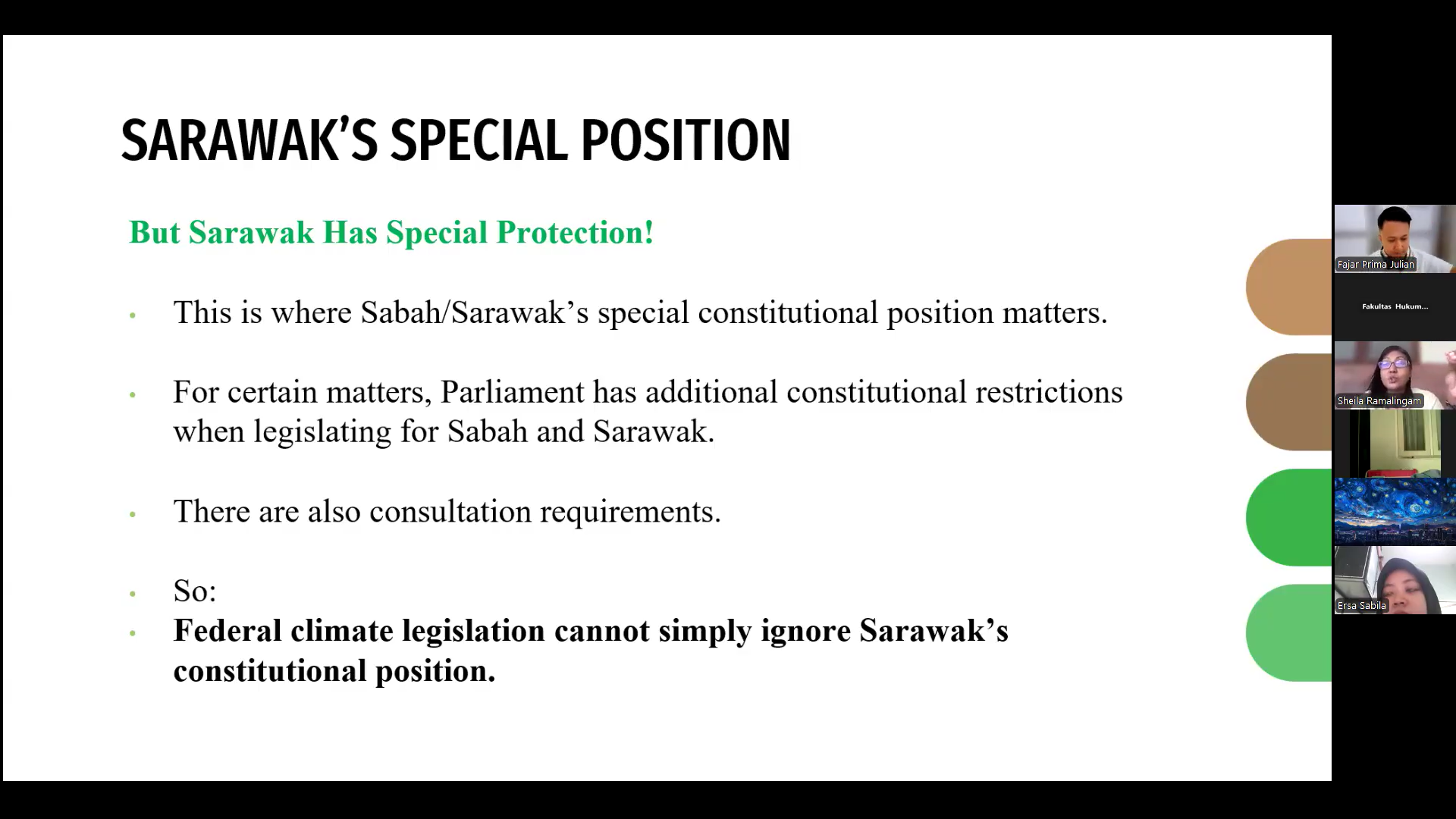
The Faculty of Law at Universitas Diponegoro (FH UNDIP) hosted Dr. Sheila Ramalingam, a Senior Lecturer at the Faculty of Law, Universiti Malaya, Malaysia, for an “Undip Global Classroom” (UGC) session on Thursday, September 24, 2026. The lecture, titled “Governing Carbon Regulation in Malaysia: Federal–State Jurisdictional Dynamics and the Allocation of Regulatory Authority,” was held online from 10:30 to 12:10 WIB, with Fajar Prima Julian, S.H., M.H., serving as a discussant for the Local Government Law course.
The lecture framed carbon regulation as both an environmental law and a constitutional law issue. By examining Article 74 and the Ninth Schedule of the Federal Constitution of Malaysia, students were introduced to the division of legislative powers between the federal government and the states, including areas of concurrent jurisdiction.
A key focus of the lecture was a comparison between the proposed federal carbon tax and the carbon levy scheme in Sarawak, established under the *Environment (Reduction of Greenhouse Gases Emission) Ordinance 2023*. The material distinguished between the status of the federal policy proposal and Sarawak’s established regulatory framework, which covers emissions reporting, emissions reduction, carbon credits, and carbon levies.
The potential for overlapping authority does not automatically imply unconstitutionality. The lecture encouraged students to evaluate the legal basis for each level of government’s authority, potential conflicts between norms under Article 75, and the residual powers held by the states under Article 77. The case of *Kajing Tubek* (1997) was also cited to illustrate the importance of precisely identifying the specific activities being regulated.
Alternative coordination strategies presented in the lecture included the harmonization of monitoring, reporting, and verification (MRV) processes, the integration of registries, the mutual recognition of carbon credits, and mechanisms to prevent double payment. This approach serves as a relevant point of comparison for Indonesia, which employs a unitary state system with regional autonomy. This UGC enriches the study of local government law by incorporating climate change governance issues and broadening students’ perspectives on the interplay among governmental authority, legal certainty, and environmental policy.