

The evolution of electronic transactions and automated contracts has reignited fundamental questions in contract law: when is an agreement formed, who is bound by it, and how is liability determined when technology is involved in the formation of the contract?
These questions were central to the Undip Global Classroom (UGC) session hosted by the Faculty of Law at Universitas Diponegoro on Thursday, October 1, 2026. The online lecture, titled “Understanding Contract Law in Malaysia: Principles of the Contracts Act 1950 and the Way Forward,” featured Dr. Mohd. Sharil Nizam bin MD Radzi from Universiti Kebangsaan Malaysia (UKM), with Bunga Jasmine Puji Hapsari, S.H., M.Kn., serving as a discussant. The session was designed for students enrolled in the Contract Law course.
In his presentation, the academic from UKM outlined the historical roots of Malaysian contract law, which is influenced by the common law tradition and the Indian Contract Act 1872. The Contracts Act 1950 (Act 136) serves as the primary legal framework for contracts, supplemented by principles of common law and equity, as provided for under the Civil Law Act 1956.
The formation of a contract was examined through its essential elements: offer, acceptance, consideration, the parties’ capacity, and free consent. A notable feature is the treatment of “consideration” under Malaysian law, which, in certain circumstances, may be provided by a third party. The lecture also covered factors that can affect the validity of consent, including coercion, undue influence, fraud, and mistake.
Remedies for breach of contract were also addressed. The teaching material covers damages under the Contracts Act 1950—including the evolution of the assessment of agreed compensation, as seen in the *Cubic Electronics* case—as well as remedies such as specific performance and injunctions under the Specific Relief Act 1950.
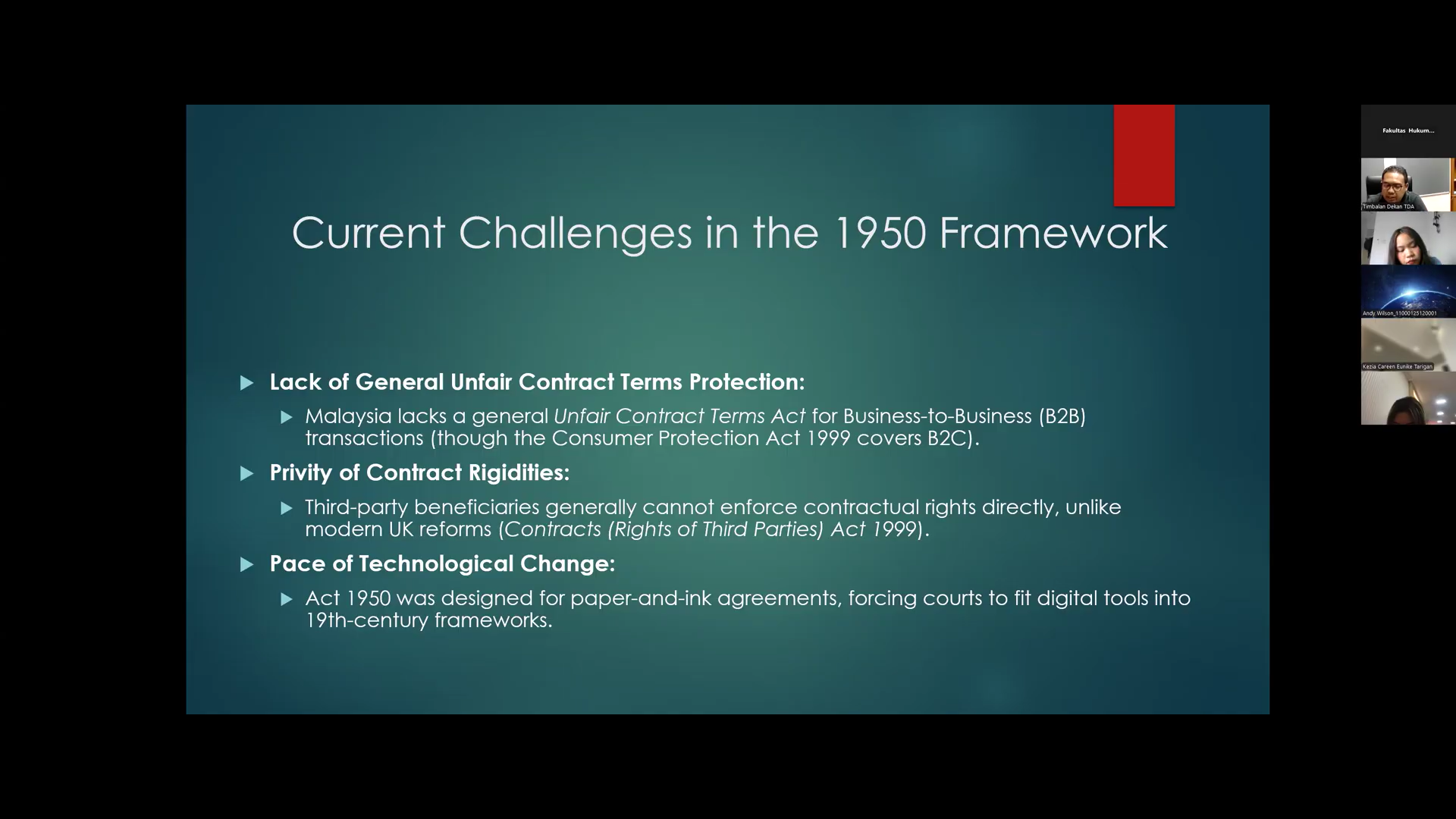
Challenges in modernizing contract law arise when rules originally formulated for conventional transactions are applied to electronic commerce, smart contracts, and the use of AI agents. While the Electronic Commerce Act 2006 and the Digital Signature Act 1997 form part of the legal infrastructure for digital transactions in Malaysia, issues concerning the attribution of actions and liability within automated contracts still require further attention.
The material also explores the regulation of unfair contract terms, the rights of third parties, and the harmonization of cross-border trade law within the ASEAN region. For Indonesian students, a comparison with the Malaysian legal system offers an opportunity to understand how different legal frameworks address similar contractual issues.
This content enriches the study of contract law by providing a regional perspective, while highlighting the importance of maintaining legal certainty and protecting the parties involved amidst evolving business transaction practices.