

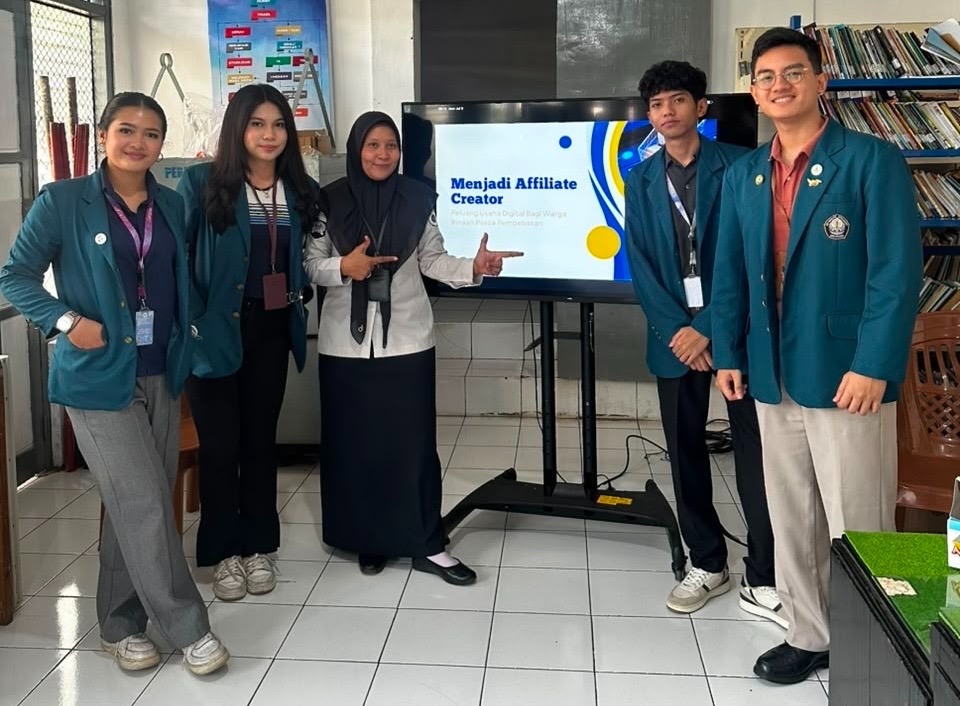
Students from the Thematic Community Service Program (KKN-T) Team 83, Group 2, of Universitas Diponegoro conducted a legal mentoring program for inmates at the Ambarawa Class IIA Correctional Facility. The program aimed to equip inmates with knowledge regarding business legality, Intellectual Property Rights (IPR) protection, and development strategies for MSMEs based on processed catfish products. This initiative represents a student contribution toward fostering inmate self-reliance, ensuring they not only possess production skills but also understand the legal aspects underpinning sustainable business development.
The activity received full support from Ambarawa Class IIA Correctional Facility staff, the Semarang Regency Agriculture, Fisheries, and Food Agency (Dispertanikap), and the Field Supervisor (DPL) for KKN-T Team 83, Group 2, Universitas Diponegoro. This collaboration among the university, local government, and the correctional facility exemplifies a synergistic approach to enhancing inmate capacity through a multidisciplinary approach that integrates technical food-processing elements with the legal aspects of MSME development.
By enhancing the entrepreneurial capacity of inmates and boosting product innovation and competitiveness, the program aligns with the Sustainable Development Goals (SDGs)—specifically SDG 8 (Decent Work and Economic Growth) through improved entrepreneurial capacity; SDG 9 (Industry, Innovation, and Infrastructure) through strengthened innovation and product competitiveness; and SDG 16 (Peace, Justice, and Strong Institutions) through increased legal awareness regarding business legality and intellectual property protection.
The series of activities began with observations and discussions involving Ambarawa Class IIA Correctional Facility staff to identify and determine the business potential of ventures already developed by the inmates. Observations revealed that catfish farming has become a self-reliance development program capable of producing a range of processed products. However, several aspects still require strengthening—specifically, business legality, brand protection, Intellectual Property Rights (IPR) applications, and marketing strategies aligned with current business trends.
Based on these observations, the KKN-T (Thematic Community Service Program) Team 83, Group 2 from Universitas Diponegoro conducted various mentoring activities. These included raising awareness about the importance of the Business Identification Number (NIB), introducing the Online Single Submission (OSS) system, providing guidance on trademark registration and IPR, and educating participants on the importance of legal protection for MSME products. Additionally, the students assisted the inmates in developing brand identities, designing product logos, creating promotional materials, and formulating marketing strategies to enhance product value and competitiveness.
The Universitas Diponegoro KKN-T team also guided digital business opportunities—specifically affiliate marketing on social media platforms—to strengthen competencies for the digital era. Through these sessions, inmates gained an understanding of legal business alternatives that leverage digital technology, equipping them for their eventual return to society.
Subakdo Wulandoro, Head of the Ambarawa Class IIA Correctional Facility, commended the innovations introduced by Universitas Diponegoro KKN-T students to support inmate rehabilitation.
“The guidance on social media affiliate programs provided by these students is highly targeted and relevant to the times. In this digital era, these skills broaden the inmates’ horizons, showing them promising business opportunities that can be pursued using communication technology once they return to society,” said Subakdo Wulandoro.
In addition to guidance provided by university students, the activity featured representatives from the Semarang Regency Agriculture, Fisheries, and Food Agency as resource persons. They provided training on processing standards for fishery products—focusing on hygiene, safety, and high market value. Participants received training in transforming farmed catfish into value-added products, such as crispy catfish, while adhering to proper food safety standards to ensure the final products were high-quality and market-ready.
Emy Handayani, the Field Supervisor (DPL) for the Universitas Diponegoro KKN-T (Thematic Community Service Program) Team 83, also supported the program’s implementation. She emphasized that the participants required entrepreneurship training combined with legal education; this combination serves as a crucial foundation, enabling them to establish independent, legal, and competitive businesses after completing their rehabilitation period.
The activities comprised material presentations, hands-on practice, interactive discussions, and direct guidance for the participants. Through collaboration among Universitas Diponegoro, the Ambarawa Class IIA Correctional Facility, and the Semarang Regency Agriculture, Fisheries, and Food Agency, the program aims to raise participants’ legal awareness of business legality, Intellectual Property Rights protection, and the adoption of business strategies aligned with industry trends. Consequently, the processed catfish products resulting from this initiative will not only be of high quality. Still, they will also benefit from legal protection and enhanced competitiveness, which will lay the foundation for economic self-reliance once the participants return to society.