

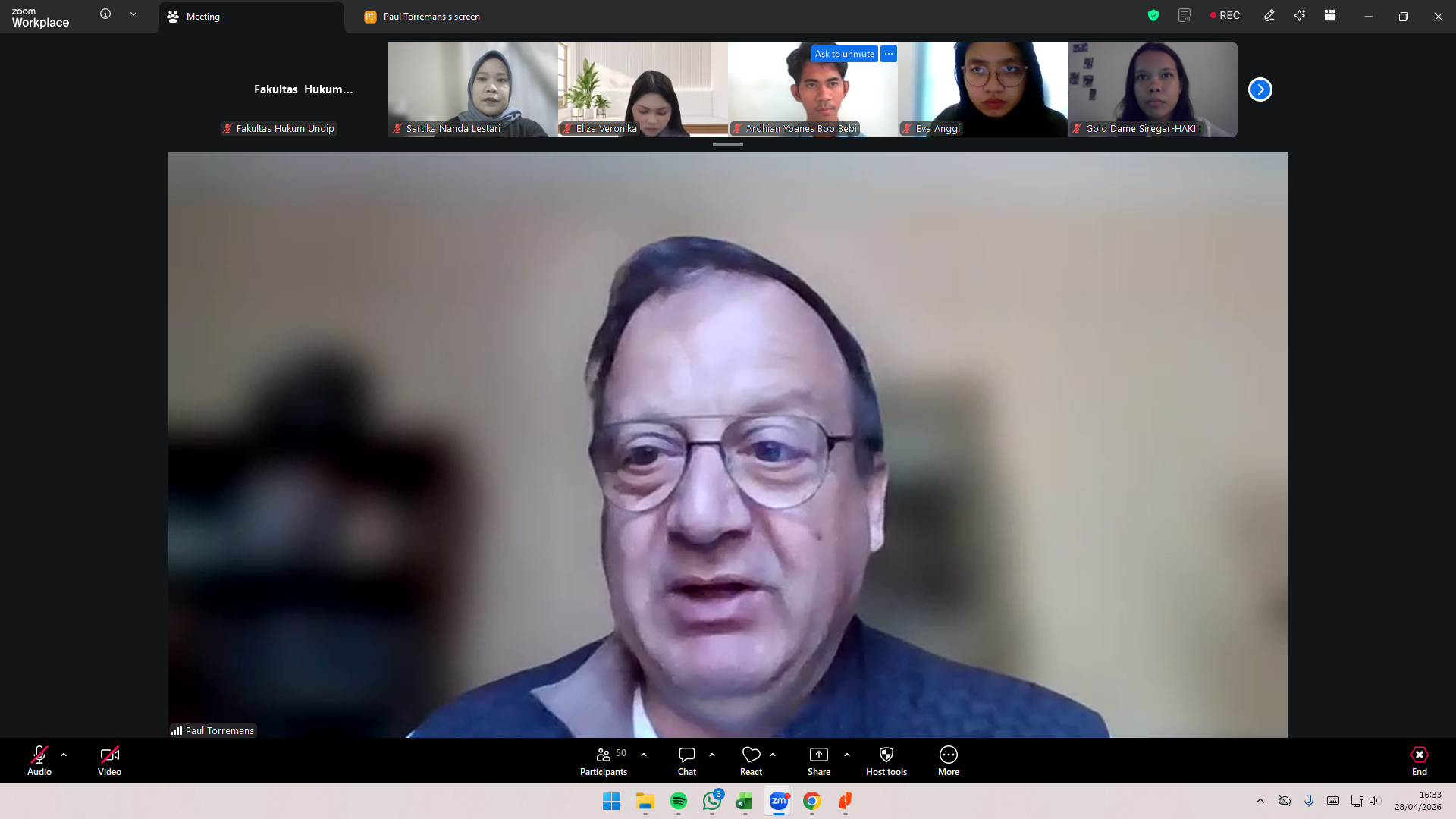
The Faculty of Law at Universitas Diponegoro once again held the Undip Global Classroom (UGC), featuring Prof. Dr. Paul Torremans, LL.M., from the University of Nottingham, as the keynote speaker. The event, held on Tuesday, April 28, 2026, raised the theme “Cross-Border Injunctions in Copyright,” with Dr. Sartika Nanda Lestari, S.H., LL.M. as the discussant.
In his presentation, Prof. Torremans addressed a fundamental issue in contemporary intellectual property law: the tension between the territorial nature of copyright and the reality of cross-border infringement, particularly in the digital context.
Normally, copyright is protected under the principle of territoriality, in which protection and enforcement are subject to each country’s jurisdiction. However, in practice, copyright infringement—particularly through digital platforms—often transcends national borders, necessitating enforcement mechanisms with cross-jurisdictional effects.
In this context, cross-border injunctions are both important and problematic instruments. On the one hand, they allow courts to issue orders that have an impact beyond their jurisdiction, effectively halting violations. On the other hand, this practice raises serious questions about the limits of national courts’ authority and the potential for conflict with the sovereignty of other states.
Furthermore, the discussion examines the varying approaches across jurisdictions to addressing this issue. Some legal systems allow limited extraterritorial application, while others maintain a strict approach to the principle of territoriality. These differences ultimately create legal uncertainty, particularly for businesses and rights holders in the global digital ecosystem.
The discussion also highlights that the effectiveness of cross-border injunctions is determined not only by the legal framework but also by the mechanisms for recognizing and enforcing foreign judgments. Without adequate cross-border coordination, court orders may lose their enforceability outside their original jurisdiction. Through this session, participants are invited to understand that the main challenge in global copyright law is not solely in the substance of protection, but in designing enforcement mechanisms that can address the cross-border character of modern infringements without ignoring the basic principles of international law.